Showing posts sorted by relevance for query cyprus. Sort by date Show all posts

Sunday, March 17, 2013

Cyprus

Big news out of Cyprus this weekend. Depositors at Cypriot banks had 10% of their deposits taken away from them overnight.

Backstory: Cyprus is a large island in the eastern Mediterranean. Over half of it is a Greek-speaking independent country called Cyprus. Cyprus is the third smallest country in the European Union, and the third smallest in the Eurozone. During the hottest part of the Eurozone crisis of the last few years, Cyprus was quiet. But, it’s moved to the top of the problem list over the last year.

The issue with Cyprus is an unstable financial sector. Many Russian oligarchs (who can get their wealth out of Russia) park it in banks in sunny Cyprus. A tax haven with a lot of cash inflows is not a recipe for good financial decisions. And where did Greek-speaking Cypriot bankers prefer to invest their deposits? Nearby, in economic basket-case Greece!*

One of the things macroeconomists worry about with financial crises is that they are contagious. In the case of Greece and Cyprus, last spring, holders of Greek government bonds were forced to accept a write-down of the maturity value of their outstanding bonds in exchange for new loans to the government. Basically, the story for those investors was: the government you invested in put its own economy in the toilet, so your bonds aren’t worth much now, and if the new loans help raise the economy out of the toilet, you shouldn’t be able to benefit from that. This is called a “haircut”. The thing is, one of the big losers in this particular haircut was Cypriot banks.

So, for a year, Cyprus has been teetering, with the government supporting its banks with emergency loans — often financed by loans from the Russian government. It’s been clear for a while that Cyprus needs a more formal bailout from the EU.

Except the EU is dominated by financially sound Germany, which is getting tired of this. It doesn’t help that bailing out Cyprus amounts to bailing out rich Russian individuals who probably got their money from graft in Russia, supported in part by cash flows from high natural gas prices paid by  … the Germans!

This time they’ve come up with a new haircut. All Cypriot bank depositors learned, after the close of business on Friday evening, that they will lose 10% of their deposits on large accounts, and 7% of small accounts. The Eurozone imposed this measure to fund about 1/3 of a $17B rescue plan that will help keep Cyprus in the Eurozone.

Of course, there were runs on ATMs on Friday. It isn’t clear if the banks will be able reopen successfully on Monday. And the legislature of Cyprus has yet to approve the move. But, how can they turn it down when the bailout package is conditional on it? Since they’re the ones who have to enforce it, you’ve got to think that they implicitly agreed to go along with this before it became official, and that they just have to make that approval explicit.

Here’s a negative view of this policy move. Here is a more positive one. Both agree we are in uncharted waters.

Do note that it is good when policymakers try new things, especially if the old way didn’t work. On the other hand, surprises like this are a big deal: remember how the American economy responded in 2008 to the government’s decision not to bail out Lehmann Brothers, as they had other failing financial institutions.

* Cyprus has not been helped by the destruction from one of the largest accidental explosions in history.

Tuesday, April 23, 2013

Required for Exams 3 and/or 4

UPDATE: LUMPING EXAMS 3 AND 4 TOGETHER DREW A LONG (AND REASONABLE) COMPLAINT FROM SHAQUEL FARR. SO, I HAVE SPLIT THE REQUIRED POSTS MORE OR LESS IN HALF. FOR EXAM 3, YOU ARE RESPONSIBLE FOR THE POSTS WHICH ARE NOT PREFACED BY "EXAM 4 ONLY".

I'm having the same problem I had last time with that widget on the right hand side.

This is the complete list of posts that are testable on April 24 and May 1. I've grouped these, the same way that I group questions on exams. Note that the size of the group is not indicative of how many points I'll award for each group's questions.

Remember that all posts back to May 1 of last year are fair game, so some of these are pretty far back. I started out with a chronologically sorted list, so within the groups they are still sorted chronologically.

To maintain some continuity, I kept posts you'd been tested on before, but I crossed them out.

Also note that there are some topics that seem useful to post at the time, but didn't seem as useful to cover in class for this semester (for example, Cyprus is in this year, so I cut coverage of China). You're not responsible for posts that are in that "Not Testable" section.


Tufte’s Short Posts

Labor Markets


Budgets and Sequestration

Unsustainability of the Welfare State

Growth

Oil

Cyprus

Old News

Not Testable

Monday, March 18, 2013

Today’s News On Cyprus

1) Headlines in mid-morning showed that the bank holiday in Cyprus has been unofficially extended for 2 more days.

2) ekathimerini, a Greek magazine reports on its site that the original demand, from the IMF and the German government on Friday, was for forfeiture of 40% of deposits. The 10% figure is the compromise.

3) Remember my post about Italy (and the goofy election results that followed their government’s attempt to get back on track)? Well, the chief economist at Commerzbank (a private German bank) has recommended to the German magazine Handelsblatt a 15% haircut for depositors in Italian banks.

4) About half of the deposits in Cyprus are Russian. And Cyprus is the largest source of foreign direct investment (buying and building physical stuff) into Russia. Clearly, this is laundering of dirty money by taking it out of Russia before putting it right back in again. Not surprisingly, Putin is ticked off about what amounts to a tax on reinvestment of ill-gotten gains.

5) Megan McArdle makes a good point at The Daily Beast:

Hopefully, savers will view Cyprus as an extreme one-off: a tiny nation whose banking system was unsustainably oversized for its economy, and whose substantial depositor base of kleptocratic foreigners made it uniquely difficult to deliver government support.  

The problem is, Europe seems to be chock full of unique, one time problems with its banking system.  There's a real risk that investors will decide that they'd rather not stick around to see what one-of-a-kind, custom-crafted solution the European ministers come up with next.

6) It appears that deposit insurance was a requirement imposed on Cyprus by the EU when they agreed to let Cyprus join. Of course, it was the EU that just abrogated the deposit insurance they made Cyprus offer.

7) The vote on the plan has been pushed back until Tuesday. It is not clear that it has the votes to pass the legislature in Cyprus. If it is voted down, speculation is that the banking system there will collapse, and the country is then likely to default.

8) Here’s another good quote from FT Alphaville:

A “one-off” often isn’t. Calling something after “stability” isn’t very stable. Saying that something is not a precedent usually makes it one.

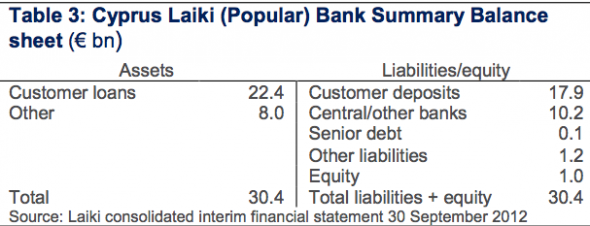
9) FT Alphaville also has the balance sheet of Laiki bank:

Note that there is almost no debt or equity. It’s all deposits. So this is less like a bank, and more like the wad of cash that people chip in and redistribute when there is a local tragedy. Also note that the “Central/other banks” entry is money already loaned by the European Central Bank under a program known as ELA. The EU refused to support Laiki on Friday because they already are supporting 1/3 of it.

10) Also, in the vein of “no one saw this coming”, FT Alphaville has a list at the bottom of the post with 10 previous articles about the decline of Cyprus.

Tuesday, March 19, 2013

What Now?

Tuesday, the legislature of Cyprus unanimously voted down the aid package agreed to on Friday.

This could be a good thing: the whole explicit taking of government guaranteed deposits is a Pandora’s box no one should have peeked into.

But, we’re not back to the situation of last Friday either.

  • Last Friday, there was a credible threat that a bank or banks would go bankrupt and close its doors. That would mean that some depositors would lose a big chunk of their wealth permanently, and a bit more temporarily as the bankruptcy was worked out.
  • Over the weekend, the plan was for everyone to lose some of their money permanently.
  • Now, the lack of plan, means that everyone will lose all of their wealth temporarily. Is that better? It now appears that the banks will not open before next Tuesday.

And, keep in mind that, like all legislators, voting against an unpopular proposal in public doesn’t mean that they aren’t still working towards the same or a similar plan in private.

What are the new developments? Well …

  • The UK stations a lot of troops in Cyprus, and they are already flying in cash. BTW: there are UN peacekeepers in Cyprus too — no doubt cash will be flown in for them as well.
  • Russia’s largest natural gas company, Gazprom, is offering to bail out the government in exchange for drilling concessions. The Russians are known for driving hard bargains.
  • More broadly, Russia is willing to offer more aid, but only if Cyprus starts divulging the names of Russian nationals with big deposits in Cyprus. That sounds like thugs angling to hit other thugs.
  • International markets in Cypriot assets have not crashed (much). This suggests that investors already anticipated, and had marked down prices, in anticipation of nonsense (like that which has taken place). This is bad news for Cyprus and good news for you and me.
  • International risk managers are starting to decline counterparty offers with Cypriot connections.
  • There is talk of capital controls.

Ah … capital controls. What exactly does that mean? The capital here is financial capital: basically, accounting entries in Euros on bank statements (remember, the banks are closed, so the only money now is the cash in people’s hands). Capital controls means that, first, no one will be allowed to transfer those Euros to a financial institution outside the country — those transactions won’t be hard, they’ll be considered a criminal activity. Second, you do permit some capital movement by forcing (or allowing) people to buy brand new bonds with their Euros. But those bonds will only be available within Cyprus, so to get your money out of Cyprus you’ll need to sell your bond to someone who … probably already has one. Good luck with that, but it is possible.

In the end, capital controls will mean that everyone loses a chunk of their wealth. It probably also means that Cyprus eventually leaves the Eurozone, and goes back to issuing its own currency. This will probably make the Mexican experience of 1994-5 look easy.

Lastly, you may have some fun with the “game” at Crooked Timber.

Saturday, March 23, 2013

Saturday’s Cyprus News

Cyprus is considering a plan to tax accounts over the guaranteed value of 100K euros at 25%, with no tax on smaller accounts.

This suggests that Russia told Cyprus that it doesn’t care what it does with the presumably ill-gotten deposits of Russians. But, there’s also the view that a lot of the (largely anti-Putin) Russian middle-class uses the Cypriot banking system to hide legitimate funds from the Russian government.

There are also rumors that ownership of the gas fields that Russia wanted is in dispute with Turkey, and the Russians don’t want to antagonize the Turks (old enemies who’ve been doing might well economically for the last few decades).

Banks are down to 2-3 days of cash to fill ATM machines.

Cyprus did pass 9 laws to 1) split banks into good and bad parts, 2) impose capital controls, and 3) raise some money by nationalizing government pension funds. These actually have nothing to do with satisfying the demands of the Eurozone directly … they’re the easy stuff. There are rumors that the Eurozone has completely discounted the pension fund idea: they want cold, hard cash as proof of seriousness on the part of Cyprus, and they don’t see pledging pension funds as talk without the walk.

The Telegraph is still live blogging tweets about the crisis … they just seem to be doing this on a day-by-day basis. Here’s Friday (the reporters are taking the weekend off). Timestamps are GMT, so subtract 6 hours (usually it’s 7, but we do daylight savings time earlier than they do in London). There are dozens of tweets and over 3K comments, if you’re interested.

There are 4 branches of Laiki (the 2nd largest and most troubled Cypriot bank) in England. Because of their organizational structure, depositors there are not covered under English law, and will be subject to any legislated actions in Cyprus. So, there’s going to be some chance of contagion there.

The Cypriot plan right now includes completely shutting down Laiki. They figure they can save $2-3B (by not trying heroic measures to turn a dead bank into a zombie bank) out of the $5-6B they need to come up with that way.

BTW: The Eurozone has increased the amount they want Cyprus to contribute by almost a billion. No reason given, but it probably reflects evolving estimates of the scope of losses that will need to be covered.

Summing up: so far the Eurozone is coming out well, with no contagion apparent, and no bad politics at home. If they thought they were punishing Russia, they instead seem to be punishing Russians. And Cypriots are still screwed:

Take a moment to realise the scale of what’s been done here. No human agency has achieved [sic] so much economic destruction in such a short time without the use of weapons. The combination of laying waste to the financial sector and tearing up the savings of thousands of residents means that Cyprus won’t return to current levels of output for a decade, a funeral pyre which bears comparison only with Greece. There are four shocks happening at once; the bog-standard austerity shock; the trauma of bank withdrawal controls; the wealth shock; and the structural shock of wiping out the financial sector. The bailout bill is certainly going to get a lot higher too, as a larger amount of debt is piled onto a smaller economy.

That said, a future as “Iceland without the fish” does have some comforts for Cyprus. Its economy actually looks a lot more like that of Iceland than that of its cousin, Greece. It’s a relatively wealthy, open economy with much stronger institutions – ranked #36 in the World Bank’s Ease of Doing Business survey – closer to Iceland’s 14, than Greece’s 79.

The debt clean-out will help growth as it always has. But cold comfort for the people sacrificed by a toxic blend of European idealism and grotesque local incompetence

Thursday, March 19, 2015

Revisiting Cyprus

The big topic in this class 2 years ago was the financial crisis in Cyprus. It's time to revisit how the Europeans addressed this issue, and how that's worked out.

First, a primer. The crisis in Cyprus was different from my coverage of Greece II this year, or Greece I whenever the last time was that I had to explain Greece to you folks. Over the previous decade, Cyprus had rapidly evolved into an offshore banking center for Russians, who deposited wealth that was often ill-gotten (proximity, warm water, and nice beaches all help). At the same time, it was admitted to the EU in 2004, and the EMU in 2009 (so the Russians were getting their money out of Russia and into the EMU). Those deposits needed to be invested somewhere, and Cypriot banks invested a lot of them in ... get this ... bonds issued by the government of Greece. When those went south, Cypriot banks became insolvent. But the EMU has organizational problems: all those deposits were now in euros which could move freely within the EMU, but the Cypriot government was responsible for being the lender of last resort for its own banking system. And they couldn't raise the money. So they went begging to the troika, and they weren't that happy to be providing deposit insurance to ... mostly Russian oligarchs. So they demanded a bail-in: in the final agreement depositors were required to contribute part of their deposits back to the banks to reestablish their capital. Basically, large depositors were told that to avoid the banks shutting down (and depositors losing everything), that half of their deposits would be forfeited, and the other half of their deposits would be replaced with shares of stock in the bank (whose value quickly fell to almost nothing) that was able to stay open due to the cash infusion. Pictures are a lot easier right: here's what a bail-in really means.

So, how'd that work out for Cyprus?

Well, the unemployment rate in Cyprus (that was in the 4-6% range for most of the oughties) climbed up to about 16% and has plateaued there.

One thing we've learned, again, is that despite economists dislike* of the political solution of capital controls ... they seem to work OK. And after 2 years, the capital controls are set to be lifted soon. If money doesn't start pouring out of the country again, then Cyprus is probably good to go. But here's a picture of what a capital control looks like.†

And, Cyprus has worked to rationalize some of its financial laws with how things are done in other countries. In particular, they're working on giving banks better recourse for dealing with non-performing loans.

But the Cypriots themselves are ticked off at the rest of the Europeans: they feel they didn't get the help they needed when they needed it, and are still paying for the trouble.

* Why do economists dislike capital controls? It's the whole voluntary exchange thing: if consumers want to move their wealth out of someplace, that's a form of free trade that probably should be permitted. Why do politicians like capital controls? Well ... hmm ... because they get blamed for financial crises, and sometimes those end with politicians getting killed.

† What specifically do capital controls mean? Pretty much no acceptance of "checks or debit cards, your checking account is now a savings account from which you can make limited daily withdrawals, your savings accounts is now a CD, your existing short-term CDs will be automatically rolled over into long-term CDs, and you can’t cash them out early."

Thursday, March 21, 2013

Thursday’s Cyprus News

  • The Telegraph (an English newspaper) is reporting tweets about the crisis in real time.
  • Market Monetarist reports that Bitcoin prices are up 50% since the tax on deposits was announced.*
  • The banks are going to be shut down in Cyprus until at least Tuesday (Monday is a regularly scheduled holiday). Marginal Revolution has dug out that there have been instances of a complete shutdown of a country’s banking system once before: four times in 20th century, bankers in Ireland went on (labor) strike. Clearly, Ireland survived. On the other hand, at the time of those strikes, Ireland was generally regarded as a 3rd world country, so it’s not clear there was as much development to be lost as in the Cyprus of today.
  • Cyprus still needs to come up with its part of the contribution: the Eurozone has indicated it will cut off lender-of-last-resort funding to Cypriot banks if their government doesn’t pony up some cash. The latest is that the government is considering nationalizing public and semi-public pensions instead of bank deposits (I don’t know what they mean by semi-public either).
  • Most shocking, at least to the bureaucrats who tend to think they’re masters of the universe, the Eurogroup held a conference call with the government of Cyprus Wednesday night — and the government of Cyprus refused to participate:

    The call was among members of the Eurogroup Working Group, which consists of deputy finance ministers or senior treasury officials from the 17 euro zone countries as well as representatives from the European Central Bank and the European Commission. The group is chaired by Austria's Thomas Wieser.

    Cyprus decided not to take part in the call, a decision that several participants described as troubling and reflecting the wider confusion surrounding the island's predicament.

    "The (Cypriot) parliament is obviously too emotional and will not decide on anything, if Cyprus does not even feel that they can attend the call it is a big problem for us," the French representative said, according to the notes seen by Reuters.

    "We have never seen this."

* Bitcoins are a completely virtual currency, unattached to any government. They are frequently used for internet transactions where … hmmm … someone’s not sure everything is on the level.

Sunday, March 24, 2013

Just the Same, Only Worse

So, the troika and Cyprus came to an agreement Sunday night. The self-congratulatory press conferences went on until 2 AM.

The just the same part is essentially the same on that the troika presented to Cyprus 10 days ago (before the disastrous plan to tax everyone).

  • The second largest bank can’t be saved. It’s “good” assets will be transferred to the biggest bank (along with all of the liabilities for money it owes to the European Central Bank). The remaining positions will be wound down.
  • The Cypriots pony up 40% of uninsured deposits (those over 100K). Hopefully most of that is Russian money, and hopefully most of that is in turn illegal Russian money.
  • The Eurozone gives them back about 2-3 times that amount to stabilize their financial system. This isn’t even twice as much as they’ve already received, so I wonder if it’s enough.
  • The legislature in Cyprus still needs to pass this.

The only worse part:

  • Cyprus now has capital controls.
  • We still don’t know if there will be bank runs this week.
  • The Cypriot business model, catering to Russians, and the prosperity that went along with that is probably dead. Russian money is now going to Latvia. That’s not necessarily a recipe for a problem, but it is possible that their financial system could be overwhelmed just like Cyprus’ was.
  • There are effectively two Euros: the one you use just about everywhere, and the one you have to use in Cyprus because of capital controls. So much for European monetary union.
  • There’s a precedent for suggesting that bank deposit guarantees can be readily overturned.
  • The troika looks like a bunch of amateurs. The pizzas getting delivered to the meetings late the night before an ultimatum came due didn’t help.
  • The Russians are surer than ever that no one in western Europe likes them.

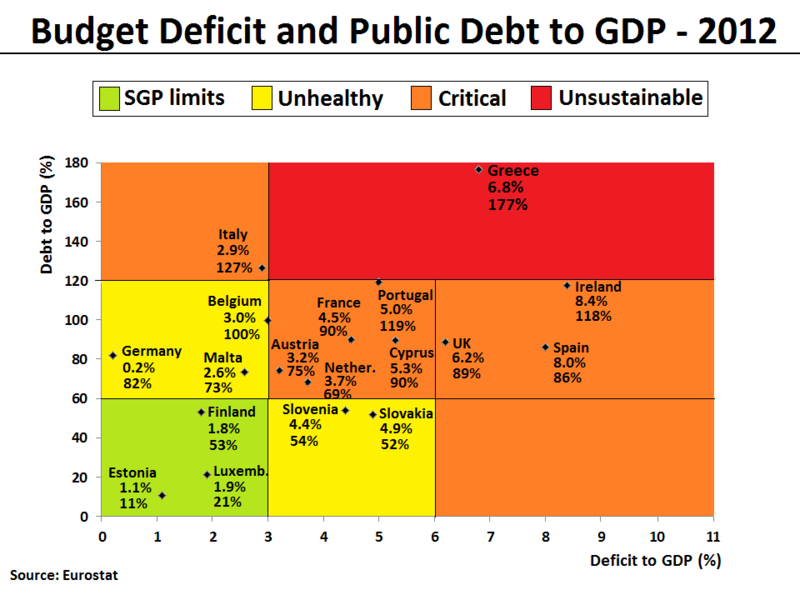
And … here’s a chart from Eurostat that indicates where we might next see trouble:

File:Budget Deficit and Public Debt to GDP in 2012 (for selected EU Members).png

We’d better hope that the Cypriot financial problems (too much Russian money reinvested in too much Greek debt) were unique, because if not, there are a bunch of bigger name places in trouble.

BTW: If the U.S. were in this chart, it would be in the same block as Cyprus.

Sunday’s Cyprus News

They’re coming down to the wire today.

  • There’s a traditional bank holiday in Cyprus tomorrow.
  • The ECB (European Central Bank) has set tomorrow as its deadline for continuing to support Cypriot banks.
  • Cypriot leaders are meeting with officials of “the troika” — the Eurozone, the ECB and the IMF — in Brussels … starting around Noon (our time).
  • Cyprus still doesn’t have much of a plan to come up with the full 6-7B the troika wants to see.

The Telegraph may have shut down its live blogging for the weekend, but another newspaper, The Guardian, has stepped into the breach to do it today.

Understanding macroeconomics requires some recognition of the “we’ve always done it this way” factor. This article from The Daily Beast goes over the historical details that are motivating Europeans to act this way.

One thing to remember in all this, when you see pictures of protesters in the streets, dysfunctional behavior on the part of politicians, and inflexibility of potential creditors is that … Cyprus is already bankrupt, in fact if not in name. Everyone is in denial … but sometimes it’s best to just admit it, and start over — here’s my friend Tim Worstall voicing that opinion. The trendy phrase this week to describe that choice is to do a “full Iceland”, since this is what that country did 4-5 years ago.

Here’s a human interest story about what it’s like in Cyprus this weekend (not required). The daily ATM withdrawal limit at Laiki bank was cut by 60% today — other banks followed suit. But, then there’s this:

French Finance Minister Pierre Moscovici put it more bluntly: "To all those who say that we are strangling an entire people ... Cyprus is a casino economy that was on the brink of bankruptcy,"

Tweets from inside the pre-big-meeting in Brussels suggest that the troika is not impressed with the solidarity fund that Cyprus has put together. Also, intelligence officials reported inflows of 12B euros worth of dirty money from Russia within the past year. That is over twice what the troika is looking for as the Cypriot contribution.

Saturday, March 23, 2013

Cyprus’ Capital Controls

Cyprus has passed some capital controls.

When you say “capital controls” to people on the street, they usually have no idea what you mean.

When you say “capital controls” to economists, they usually have no idea what you mean either. I know I don’t until the specifics come out.

Typically though, these mean any sort of legal measures that politicians can dream up, that they have hopes of enforcing, with the intention of slowing down the movement of money out of a country. In this case:

… The Prodigal Geek, has seen the full banking bill (in Greek) and gives a summary of what the wide-reaching capital controls would entail.

• Restrictions in daily withdrawals

• Ban on premature termination of time savings deposits

• Compulsory renewal of all time savings deposits upon maturity

• Conversion of current accounts to time deposits

• Ban or restrictions on non cash transactions

• Restrictions on use of debit, credit or prepaid debit cards

• Ban or restriction on cashing in cheques

• Restrictions on domestic interbank transfers or transfers within the same bank

• Restrictions on the interactions/transactions of the public with credit institutions

• Restrictions on movements of capital, payments, transfers

• Any other measure which the Finance Minister or the Governor of Cyprus Central Bank see necessary for reasons of public order and safety

To summarize, starting in the middle: without checks or debit cards, your checking account is now a savings account from which you can make limited daily withdrawals, your savings accounts is now a CD, your existing short-term CDs will be automatically rolled over into long-term CDs, and you can’t cash them out early.

This is my opinion, but I don’t believe capital controls this aggressive have ever been used in a developed and/or European country in the last 50 years.

Also, make no mistake: this is like creating a second-class Euro just for Cyprus — basically it’s scrip. So much for a single currency. And check this out:

Cyprus is odds-on favourite with bookmakers William Hill to be the first country to leave the euro. Having been a 20/1 shot to do so a week ago, Cyprus is now 1/2 favourite, displacing former odds-on favourite Greece, whose odds have now gone out to 7/4.

Tuesday, June 18, 2013

Cyprus Update: Capital Controls Aren’t Stopping Capital Flight

It’s been 3 months since the Cypriot crisis was “solved” with capital controls.

Those controls were intended to keep capital (movable, fungible wealth) from leaving the country. A country needs capital for investment and economic growth, but who would want to keep capital in a place where the government can tax it away to cover the mistakes of others? So, when you’re like Cyprus, capital leaves the country. Capital controls are supposed to limit that.

Now … we don’t have a counterfactual: we know what the data says happened with the controls in place, but we don’t know how much worse (or possibly better) things would have been without them.

Anyway, the data isn’t pretty. Twice as much capital left Cyprus in April (after the controls were put in place) than in March (when the country basically was shut down).

Cyprus’ overall problem is roughly in the (low to mid) tens of billions of dollars.

And with capital controls they still lost $3B in a month.

Which money left? About half was foreign, and about half was Cypriot. It’s not good when your own natives are taking their wealth out of their own country.

And surprisingly, a lot of the money that left was already denominated in dollars. That is money that is held in a Cypriot branch of an institution that operates in the U.S. That money should have been safe already, since it kinda’ sorta’ is already non-Cypriot. But it moved too, probably to American financial institutions without operations in Cyprus at all. This is what you do if 1) your long-run goal is to “get the heck out of Dodge”, or 2) you are selling your wealth to family and friends in foreign countries in exchange for basic products that they are shipping to you (in short, you can’t get stuff like, say, printer toner because you don’t have any cash to buy merchandise, and the stores don’t have any money to buy inventory).

Via Marginal Revolution.

Tuesday, March 26, 2013

Continuing Weirdness In Europe

It’s all happening live:

  • Banks in Cyprus are still not open. Now they say Thursday.
  • The rumors are that withdrawals may be limited to 30 Euros. Leaked memos indicate that bank employees haven’t yet been told what the limits will be (probably so they don’t tell their friends and family).
  • A poll by Stern (the largest news magazine in Germany) shows that over half of the German population no longer believes their deposits within Germany are safe.
  • Cypriot government opposition to its largest private bank taking (Bank of Cyprus) over the emergency loans (ELA) issued by the European Central Bank (ECB) to the second largest bank (Laiki) was apparently over fears that the “better” bank will not be able to continue payments on that many loans for more than about 6 months.
  • Fitch (a rating company) has downgraded the ratings of Cypriot banks, and its government. Laiki Bank is now rated as “in default” even though it hasn’t been open for 2 weeks.
  • There were large protests of students on Tuesday in the Cypriot capital of Nicosia. Only 3K, but that is proportional to 1,200K in the U.S. How would our country behave if there were a million students marching in D.C.?
  • The U.K. sent a new shipment of cash to British citizens in Cyprus. It’s 13 times larger than the one last week.
  • The final percent for the “haircut” won’t be announced until Friday. They are talking up to 80%, with it taking up to 7 years to clear out claims on the other 20%.
  • British expatriates and retirees around the Mediterranean have been calling in to their financial advisors for advice about the safety of their money in the PIGS.
  • Sheesh: “Eurogroup president Jeroen Dijsselbloem is at it again. He has now reportedly said that a levy on wealth is defendable in principle. He adds that the majority of Cyprus deposits aren't savings.” [emphasis added]

Also Paul Krugman (a liberal) agrees with the view of Tim Worstall (a conservatives and/or libertarian) that I discussed on Monday — that Cyprus might as well declare bankruptcy, leave the Eurozone, and start fresh.

Sunday, March 17, 2013

More Light than Heat About Cyprus

The Financial Times is getting closer to the heart of the matter.

The European Central Bank determined last week that the second largest bank in Cyprus, Laiki, was in such bad shape that they could not justify giving it any service as lender-of-last-resort.

So, the proposition given by the Eurozone to the government of Cyprus was either 1) do nothing, Laiki fails this week, and you are on the hook for 30B euros of insured deposits, or 2) agree to the haircut which covers a third of the bailout package we’re willing to give you.

BTW: There are discussions in the Cypriot government about convincing the Eurozone to accept a bigger haircut on large accounts, in exchange for a reduced haircut on smaller accounts.

FWIW: It’s hard to get perspective on this, because Cyprus isn’t that well known. It makes up just 0.2% of the Eurozone economy. That’s comparable to Vermont relative to the U.S. economy. But, with an out-sized banking system: something like all of New England’s financial system crammed into Vermont.

N.B. # 1: You could and should view this as a tax on wealth, and many people are describing it this way. Keep that in mind when you hear 99 percenters talking about taxes on wealth, financial transactions,and so on.

N.B. # 2: The word “bail-in” is being tossed around. A bail-out is when outside money is brought in to make your operation solvent. A “bail-in” is when money you’ve already put into an operation is permanently committed without you being able to get it out again: sort of like having your bonds converted to (worthless) stock, with the chance that you might get lucky.

A Little More On Cyprus

Some of It Was True … has been following the situation more closely.

… those who noted that the Cyprus bailout took place ahead of a local bank holiday on Monday were onto something.

Cyprus was a British colony, and its financial system is modeled after the British system. In Britain, bank holidays are regular holidays that can be used to give regulators extra time to make sure that the books of the banks are in order. So doing this move in Cyprus when they have a bank holiday may be a sign that banks will be shuttered or reorganized too.

Four choices have been faced ahead of every [Eurozone] bailout; screw the local taxpayer; screw the creditors; the Germans pay for everything; or fiddle the numbers in the hope the crisis just goes away. The Irish programme rested heavily on option 1, the Portuguese and Greek (especially) on options 1 & 4. Hopes for option 3 (ESM [kind of an EU version of our TARP] buys shares in the banks) are dead in the water. This programme indicates option 2 gaining in strength, 3 & 4 sinking.

It actually may be a good thing if option 2 is gaining steam, since there are many deep pockets moving presumably ill-gotten money through the European backwaters.

… senior bank bondholders are being protected to save other banks. But this means that Cypriot depositors are being sacrificed that depositors in the rest of Europe can be protected.

This is definitely a move to spread the pain to prevent a contagious spread of the Cypriot crisis to banks in other countries. This then is similar to the U.S. bailout of AIG in 2008; too many foreign financial systems were dependent on the cash flows coming out of that operation, making it risky for it to just be near the borderline of bankruptcy.

And the Russians? … I would guess the thinking is that 10% is seen as a cost of doing business when it comes to money laundering … If the infliction of losses on small depositors has a purpose, it’s probably to reassure the Russians that they are not being discriminated against. Yes, I may have thrown up a little in my mouth typing that.

LOL.

My own judgement is that inflicting costs on depositors in principle is an extremely important one, but that not sparing the small depositor is worse …

Perhaps so. The long-term problem is that if you don’t do something like this, you end up with zombie banks, that face no risk from taking extravagant gambles: heads they win, tails … well … the rest of us pay.

The bottom line for us here in the U.S. is that you need to hope that this sort of move does preclude contagion, because that can reach back to our financial system too.

Via Marginal Revolution.

Tuesday, April 30, 2013

How Bad Are Things In Europe?

Here’s a chloropleth from the April 26 article from The New York Times entitled “Southern Europe’s Recession Threatens to Spread North”

13-04-26, New York Time Screen Capture Recession's Daunting Reach

Note how few EU countries match the (below average) growth rate that America put up over the last year.

Also, recall that Russian money that fled Cyprus is now reported to be going to Latvia. Latvia is a member of the EU (like Cyprus) but is not a member of the EMU (unlike Cyprus) — so it’s reasonable to conclude that the situation won’t evolve the same way. Even so: check out Latvia’s growth rate: inflows of foreign cash are apparently good for you up until they’re bad for you.

Friday, March 22, 2013

Revisiting the Argentinian Nationalization of YPF

About a year ago, I posted about how the government of Argentina nationalized the assets of the oil company, YPF, a division of the Spanish company Repsol.

This week I received a paper which surveyed finance professors about the value of YPF at the time of the nationalization. The consensus was about $10B.

Argentina has still offered no compensation to the owners of Repsol.

There are two broad similarities to this semester’s crisis in Cyprus. First, it isn’t impossible for governments to steal billions of dollars. Second, Argentina defaulted on its debts about 10 years ago, and implicitly stole from many retirees (mostly in Italy and Spain) who had bought Argentinian bonds.

So, we’ve seen stuff like the Cyprus situation before. It doesn’t end well. The difference this time around is that Cyprus is inside the EU.

Thursday, March 28, 2013

No Bank Run Yet

The capital controls are in place, and while there were lines, there were no runs when Cyprus opened its banks today.

Do note that it is 2013, and most people do their banking over the internet … so the real thing to look at is not 20th century style lines, but the data on internet withdrawals that will come out over the next several weeks.

How long will the capital controls be in place? No one knows. They Cypriot government says a week to a month. This does not seem historically informed: Iceland is now in year 5 of its controls, and the UK maintained wartime capital control from 1939 to 1979 (that’s not a typo). Note that both of those places had profitable industries other than financial services. Cyprus is left with serving daiquiris by the pool.

I didn't know this:

Still, the experience of other capital-controlled countries gives us some lessons about how these regimes work out over time. Capital controls turn into trade controls, as the locals attempt to find ways to turn hard assets or non-banking services into foreign exchange. At some price, for example, you can buy a boat in Cyprus with post-haircut, capital-controlled local deposits, sail it to Lebanon, and then sell it for real, usable money. The same with antiques, jewellery, or anything else you can think of. Even capital goods such as fork lifts can be motored off in the middle of the night.

Of course the authorities anticipate some of these problems, but there are always new ones. Particularly after the initial shock of control imposition wears off, the population turns from productive effort to finding ways to game the system. Some cultures are more resistant than others to this change in character, but in all cases social cohesion and respect for law are eroded over time.

There are winners, of course. As one of my sovereign restructuring friends says: “The financial institution that comes out ahead is the Banco de Mattress. After all, if you are a small depositor, you can’t turn up with your €25,000 in cash in Frankfurt and expect to be able to open a bank account. You can, though, just keep it at home or in your own safe.”

Fixers and intermediaries become sought after; having a cousin in the central bank will be a mark of social distinction.

Thursday, March 19, 2015

Will Greece Get Capital Controls?

The EMU imposed capital controls on Cyprus after their financial crisis in 2013. Will Greece get capital controls when (and if) it becomes cleared that their crisis is only on hold?

But Cyprus' problem was different. It was mostly about the Cypriot government letting its banking sector bloat up with presumably ill-gotten Russian deposits, and then being too small to act as a lender of last resort when those banks became insolvent.

Greece ... has bigger problems. Recall the post from earlier this semester: people are starting to use the word "failed state" when referring to Greece. This is a word we usually reserve for places like Somalia.

Even so, if the money starts flowing out again, capital controls may be coming. The problem is that half of the assets of Greece's banking system are IOU's issued by the Greek government that it promises to pay out of tax revenues. But it's having trouble collecting taxes.

What we need to pay attention to over the next few months is the decisions that the European Central Bank (ECB) makes regarding Emergency Liquidity Assistance (ELA). If they are tight with that, then the government of Greece may need to impose capital controls.

Also keep your ears open for any data about capital flows out of Greece.
This chart is poorly explained: what bears watching is the bars and the scale on the right. I'm eyeballing that and seeing €4B in December, €13B in January, and €4B in February. Does that mean that the smart money has already left, or that Greeks were holding out hope in February that Syriza might be able to make a better deal?

Saturday, March 23, 2013

Cyprus’ Solidarity Plan/Fund

Cyprus’ alternative to the Eurozone’s demand for 10% of bank deposits is to put together something they’re calling their solidarity fund.

What this is has not been clear the last several days.

Now, Open Europe, an economic/political think tank has delineated, via tweet, what’s in this:

image

Frankly, this looks like the sort of plan that you put together towards the end of Monopoly game when you’ve just landed on Boardwalk with a hotel.

I’m not sure what they mean by the pension fund is “only solvent due to govt transfers”. Perhaps it is underfunded? Perhaps they are including the scheduled infusions of pension payments that haven’t been made yet? Anyway, it sounds dicey.

The gas reserves are the big item … but remember the Russians already passed on this. How great can it be if the people you’ve screwed over won’t make an offer on the only thing you’ve got?

The other thing about that gas item is the no money until 2018 part. This is where an economics student needs to think about opportunity costs. If the value of the stock of gas is 30B, and you figure it needs to kick off a minimum return of 10% per year, then the opportunity cost of this is $3B per year right now. So, they Cypriot dream of selling their mineral rights is like asking the people that you owe money to pony up $3B per year for 5 years until they might start getting some positive cash flow. To me … this sounds like asking for a loan to pay off a loan.

Via Marginal Revolution.