Showing posts sorted by date for query why is macro so hard -required. Sort by relevance Show all posts

Thursday, October 24, 2024

Why Is Macro So Hard? (Here We Go Again) Another Economist Who Isn't an Economist At All

OpenAI has hired their first Chief Economist.

That person is Aaron Chatterji, a professor from the business school at Duke.

His CV is available on online. Here's some highlights:

  • He was a member of the National Economic Council in the Biden White House (that's the office that's mostly attorneys)
  • He was Chief Economist at the Department of Commerce (you'd think they might know better)
  • He was a member of the Council of Economic Advisors in the Obama White House (OK, that's good)
  • At Duke, he's listed as a Professor of Strategy in their business school. BTW: Duke has a Department of Economics (full of economists), but it's not in their business school.
  • He held a visiting position at Stanford where the title was Professor of Public Policy
  • He got a Ph.D. from Berkeley in "Business and Public Policy"
  • He got a  BA in economics from Cornell.
  • Of his 33 journal articles, the most popular venue (by far) is Strategic Management Journal.

What's my point in all this? I'm pointing out a weird conjunction of events: a general feeling that the economy is not doing well, along with a propensity to put people in charge of economic decisions who aren't economists. If everyone always felt the economy was doing OK, I don't think this would be a problem. As it is, it seems like a red flag to me: why is it so important to call people economists when they aren't?

Tuesday, October 15, 2024

Why Is Macro So Hard? Another "Economist" Who Isn't an Economist At All

This one is pretty hard to believe.

But there it was in the Wall Street Journal: "The Economist Whose Contrarian Streak Has Gotten Attention in Biden and Trump Camps".

Pettis isn’t a trained economist. He describes himself as “a finance guy,” ...

Now, my own biases may be creeping in here, but I think a lot of the fascination of the press with Wall Street types borders on parasitic (or worse, but this is a family blog). 

Anyway, it's a fact. So as an economics student, please put on your tinfoil hat when anyone ... I repeat ANYONE ... starts implying that people involved in buying and selling assets have special insight to macroeconomics.

A career on Wall Street ... worked in the bond divisions of investment banks Bear Stearns and First Boston. 

And for 20+ years he's been an finance professor at a very good university in China. Without actually having a degree in finance (he has an MBA with a focus in finance, and a Masters of International Affairs).† His Wikipedia page notes that he was a bond trader ... so basically ... he started in sales.

Oh ... and a punk rock music producer and night club owner in China.

Who sings this guys praises? Well, the article quotes Robert Lighthizer, Trump's first term trade representative. Again ... the problem is ... Lighthizer is an attorney, not an economist (seemingly not even a undergraduate major). And Oren Cass (another non-economist who plays one on TV) whom I trashed in the immediately preceding post. Go figure. Oh, and Katherine Tai, Biden's current trade representative, who happens to be an attorney (and definitely has zero economics training as an undergraduate or graduate student).

Who  doesn't? Well they quote Maurice Obstfeld, who's a likely winner of a Nobel Prize in the next 10 years or so for his work in trade.

“The world is really complicated. For Michael Pettis, the world is really simple,” said Maury Obstfeld ...

Maury? Can't say I've heard that before.

***

For the umpteenth time in my career ... there is nothing wrong with having opinions about macroeconomics ... and no requirement that one have any background in economics ... but the analogy here is that we keep getting told to pay attention to what the assistant basketball coach has to say about modern dance.

Macro is hard. And macroeconomists are wrong about it all the time. But articles like this don't even note that we probably a bit of an edge on this topic.

FWIW: the article is written by 2 Wall Street Journal reporters, and at least one of them did major in economics as an undergraduate.

† Do note that this sort of background would not qualify Pettis to get a tenured or tenure-track job in a finance department in an AACSB accredited school, although his experience and two books would probably be enough to keep him as qualified lecturer once he had his foot in the door.

Sunday, April 21, 2024

Applying the Handbook: Sweden and Finland, Turkey, NATO and the OECD (and Kurds, Sunnis, and Indo-European Languages)

There's a lot to unpack in this one. But it's a great application of the implications of the measurements in Chapter VI of the Handbook, and the observations of growth told throughout.

For most of its history, Sweden and Finland weren't in NATO.

Then Russia invaded another non-NATO country in Ukraine, and both countries reconsidered. Gee ... ya' think?

Except Turkey was in NATO, and didn't want Sweden and Finland in the club. And NATO is a military alliance: you don't get in without unanimous approval of your new allies.

After about a year, Finland got in. After about another year, Sweden got in (just last month).

How does that all work??

***

First, Turkey is super-underrated by Americans as a macroeconomic power. It is not as big as the "big 4" western European countries, but it is solidly in the second tier with Russia and Spain (see the top deciles for GDP in Chapter VI). So it has weight it can throw around. It's also economically bigger than Sweden, and quite a bit bigger than Finland.

Second, given the war in Ukraine, Sweden and Finland wanted in to NATO. So what would they give up in the bargain?

Third, Turkey blocked them for a several of months, bargained for and got some concessions. Hmmm ... and Turkey's economy is bigger than both Sweden and Finland (maybe there's something to this macro stuff), and that accounts for a lot of their influence.

***

NATO is the military alliance, and the OECD is the overlapping economic group of developed and developing capitalist countries. 

Sweden and Finland were not members of NATO. Turkey was. Sweden, Finland, and Turkey are all OECD members too. It stands to reason that the Turks view themselves as fuller members of the club of important countries, in a way that American might not recognize.

Also, Turkey is a really important NATO member. Consistently active since the start, and militarily large. Also, given western European prejudices about language, religion, and skin color ... NATO is Turkey's connection into the club of big, important, countries. So, if Turkey objects to Sweden and Finland joining, NATO will listen because Turkey has been trying very hard to get western Europeans to pay attention to them and this is their wedge issue to make that happen.

***

Why is Turkey in NATO?

This actually goes back 4500 years.  The first horse-oriented people to ride out of the Eurasian steppes and conquer everyone in their path was ... us. (For reference down below, the Indo-European language group is called that because some went west to Europe and others went south to what is now India, Pakistan, Afghanistan, Iran, Iraq, and Turkey). Then came the Huns, Avars, and Magyars, who over about 500 years eventually became Hungary. Third came the Turks, who stayed in what is now called Turkey, and after them, the Mongols who rode back home.

Over the next several hundred years, the Turks fight off Crusaders, and eventually conquer the Byzantine Empire. Through the 16th and 17th century, they vied for being the strongest empire in Europe.

But it was a loose, decentralized, empire: the Ottoman Empire was ruled by Turks, but it was much more than them and not tightly held. As an example, the Barbary pirates against whom  America fought its first war after the revolution (you know, as in the Marines song "... To the shores of Tripoli") were, in fact, nominally subjects of the Ottomans.

Three things happened as the Ottomans faded from their peak. First, some of the European states started more seriously centralizing power over their nations to form some of the nation-states we still have today. Second, it seems to have been a coincidence, but economic growth started up in the same region as those new western nation-states. As they got economically bigger, they started to extend their political and military influence. And third, a more eastern nation-state in Russia started picking off parts around the edges of the Ottoman Empire.

Both the perception and reality we still have that Russia and Turkey are poorer and somewhat backwards is not so much because they did anything badly. Rather it's that western Europe and America opened a gap by growing first. Turkey didn't get poor. Turkey was normal. Instead, other parts of the world got abnormally rich first. Russia and Turkey did too, but because they weren't as close geographically to the origin of economic growth, they started later. They are poorer today because we got the jump on them then.

But the Russian Empire did centralize into a nation-state and the Ottoman Empire did not. Because it could focus its resources, for 2 centuries it took lands away from the Ottomans.

Now, along come the Prussians who wrest dominance of the Germans from the Austrians in the 1860s, and form another empire. It's insufficiently appreciated in the U.S. the extent to which the new German state always regarded Russia as the big threat. Everyone else, including France and England, was an afterthought. So who do the Germans go looking for as an ally in Europe? Russia's enemy: the Ottoman Empire. And recognizing that economic growth was already happening there too, they put a lot of extra economic support into that region in the years leading up to World War I. 

Not surprisingly, the Ottoman Empire fights on the side of the German Empire in World War I. And Americans tend to forget (or never knew) that they hold their own on several fronts, including one against Russia ... because they were a bigger player than we care to know.

After World War I, three fading empires are broken up. Austria-Hungary becomes a bunch of little countries along ethnic lines. Russia loses some territory, and turns inward as the Soviet Union. And the Turks lose a lot of loosely held territory, throw out their sultans, and establish a nation-state that's centered on a civilian controlled military as the most effective institution. But, while it's a very stripped down empire, it's still ruling some other nations. More on that later.

To some extent, the Nazis line up the same team for World War II: Bulgaria, Hungary, and Austria fight with them both times (and the Czechs were more solid than they care to admit). They tried pretty hard to get Turkey involved too (if you're curious, a little historical reading shows those Nazis in the Indiana Jones movies were not just randomly placed in the Middle East ... they really were there opportunistically in the 30s). To its credit, the new Turkey was not interested.

***

So Turkey is trying to be new and different place after World War I, and after World War II they want everyone to remember that they really were different the second time around and had stayed neutral.

And, in the wake of World War II, the western countries return to worrying about the Soviet Union. And Turkey chimes in to point out that they've had problems with the Russians for centuries.

So when NATO forms, Turkey is admitted almost immediately. And historically, Turkey has been the 3rd biggest contributor to NATO. Why? Partly because they want to be supportive to help change western perceptions of them, but also because they're macroeconomically bigger than Americans tend to recognize: in the 92nd or 93rd percentile according to Chapter VI in the Handbook ... comparable to Mexico. And they have an effective institution in their civilian-controlled military which can be directed to serve larger aims.

And all through this period, Turkey's economy is growing, and Turks are becoming richer. In the 57th or 70th percentile according to the Handbook: comparable to the Russians, Mexicans, or Chinese.

The bottom line for macroeconomists is that a country like Mexico is aspirational for many other countries. Well, Turkey is also aspirational for many other countries, and Americans should understand that better. More on that later.

***

So why was Sweden not in NATO?

It is believed this was mostly threat based. Sweden was officially neutral in both World Wars, but was pretty cozy with Nazi Germany. So after World War II, the Soviets used their size to lean on Sweden and tell the littler country to keep its nose clean going forward.

Again, the country with the bigger GDP ... 3 to 7 times as big according to Chapter VI ... gets its way. And the Soviet Union was even bigger than its remnant in Russia.

***

And why was Finland not in NATO? This is more complex.

The Finns had been dominated by the Russians since the early 18th century. Then what is now Finland was part of the Russian Empire. But the Finns freed themselves during the Russian Revolution. 

At the beginning of World War II, Hitler and Stalin were allies. One of the things the Soviets got out of that was a promise that the Nazis wouldn't object if the Soviets attacked Finland. Which they did a few months later. 

Fairly obviously then, when the Nazis turned on the Soviets in 1941, the Finns went along for the ride for a few years.

But, as the tide turned, Finland switched sides in return for promises from the ascendant Soviets that they would not invade.

So after the war the Soviet pitch was more along the lines of you're our ally now, so don't even think about joining NATO. Probably the only reason they didn't join the Warsaw Pact was that the Soviets never stationed troops there.

Again, the country with the bigger GDP gets its way. Russia has 5 to 15 times the GDP of Finland, and is right next door.

***

None of this addresses why Turkey would not want to have Sweden and Finland as allies in the 2020s.

There's two parts to this.

One, Turkey is economically bigger than either Sweden or Finland, so it's very likely that the Turks would be helping to defend the Swedes and Finns, rather than the other way around. Again, consulting Chapter VI, Turkey is a third bigger than Sweden, and 2-3 times the size of Finland. Turkey also has that big and effective and dispatchable military.

Secondly, Sweden and Finland have a history of supporting militant minorities in Turkey. 

That's probably not that smart.  

And, I don't know that there's any evidence of this, but it makes sense to speculate that Russian intelligence encouraged their smaller non-enemies in the north to support divisiveness in their bigger enemy to the south. 

Again, the story is of an economically bigger country (the Soviets and then the Russians), that leans on smaller countries (Sweden and Finland), to make trouble for the medium-sized country (Turkey).

***

In the middle of this are the Kurds. Who are the they, and how did they get involved in this situation?

Again, there are several threads from Chapter VI in the Handbook at work here.

In the 19th century, there's greater interest in nationalism, and the idea that countries should coincide with nations with their own state.

But there's also the reasonable 19th century observation that most of the country-nation-states that are growing in economic power ... were also pretty big to begin with. So there's a bias against small countries because it was thought they would not be viable. The idea that a Switzerland or The Netherlands could become economically powerful didn't happen until after World War II. This is the polar opposite from the view from the 1960s onward that we ought to give every nation a chance to grow and be rich no matter how small. And honestly, the jury is still out on whether that happens in anything other than the special cases of banking and tax havens (see the discussions in Chapter VI on richness vs. bigness).

Anyway, that bias is there after World War I. So when they completely break up the empire of Austria-Hungary, mostly break up the Ottoman Empire, and lop some chunks off what was the Russian Empire, the plan is to make sure the new countries succeed by making them big enough.

But what if the nations aren't big enough to reach whatever size threshold was envisioned for a country? Well, that's how we got Czechoslovakia! Which amicably broke into 2 countries about 30 years ago, because the Czechs and the Slovaks don't view each other as the same. That one worked pretty well. But it's also how we got Yugoslavia, which broke apart with genocidal events at about the same time. 

And it's also how we got Iraq! Which was never a country until the U.K. (again, a bigger economy) decided to clip economically desirable parts (full of oil) off of the economically smaller and poorer Turkey between the wars. But, the region had smaller nations, so it cobbled 3 bigger ones, and a some smaller ones, into one country. One of those bigger groups was the Kurds, some of whom were also in Persia (before it renamed itself Iran), and a bunch of whom were left in the new-ish Turkey.

***

Update: I forgot to mention that there were several treaties involved in the carving up of the Ottoman Empire. An initial one signed while the Ottomans still held power did give the Kurds their own country mostly inside current Turkish borders. But before it was put into effect, the Ottomans were overthrown, and the new Turkish government negotiated new treaties, the most important of which did not give the Kurds their own country.

***

So what makes the Kurds view themselves as a nation? 

Ethnically and culturally Kurds are related to the Iranians, and they speak a language that is distantly related to English, but fairly closely related to Persian (the prime language of Iran). Recall that these languages are hugely distinct from Turkish. 

However, Islam has two big divisions: Sunni (about 80%) and Shia. And they regard each other as apostate (analogous to Catholics and Protestants in Europe in the 16th century). The Iranians are Shia, but the Kurds are Sunni. 

So Iran has a majority of Shia Iranians, and a minority of Sunni Kurds. Iraq has Sunni Kurds mixed with some Shiites, and Arab Sunnis. And Turkey is Sunni, but the Turks speak a vastly different language from the Kurds, and have dominated them for centuries. 

So the Kurds think of themselves as a distinct nation without a country or state.

And that tends to foment violence and revolutionary tendencies. 

Into which the Swedes and Finns blundered by accepting Kurdish refugees for decades ... probably because they were an oppressed nation. Which is very big-hearted. But also, it's a recipe for trouble because, as is typical, there's exiled revolutionaries and militants mixed in.

There's also a problem that we've seen globally over the last 50 years. It used to be that oppressed minorities didn't travel very far. Everyone was poor, and maintaining links to home if you emigrated was not cheap. Think about how a few centuries ago very few Europeans could afford to move to America. And how even as that became more common, and people were drawn from increasingly remote parts, it was too expensive for most to stay in touch with the home country. That's not really the case over the last few decades: more people can afford to move around the globe, and maintain better ties with their homelands. So as everyone gets richer, because everyone eventually hits that kink in Chapter II of the Handbook, we see a lot of local militant/terrorist/revolutionary activity extending tentacles like an octopus from a head that's safely at a distance.

Thus, Turkey has a long-standing beef with Sweden and Finland that they harbor and maybe even nurture terrorists able to reach and target Turks in Turkey.

***

We are probably never going to know what the Finns and Swedes conceded to the Turks to get into NATO. But it took the Finns a year to agree to it, and it took the Swedes two ... so it is probably not a minor thing. 

It should also be fairly clear that there was probably a huge pressure on Turkey from the more western countries in NATO.

Also, keep in mind that Turkey is aspirational for lots of developing countries around the globe. They probably don't think they can be like Sweden or Finland, but they can be like Turkey some day. So it's a good bet that a lot of states around the world had their diplomats tell the Swedes and Finns to back off a bit.

 One thing is for sure: it is probably very bad for the Kurds who are still in Turkey.

Friday, April 2, 2021

Noah Smith On the New Macro

Dramatically, Noahpinion calls it "The Return of the Macro Wars".

Because the Biden administration is borrowing and spending a lot of money, a huge debate has erupted about whether that’s OK. And where the original Macro Wars were fought on the blogs, the current ones are more likely to play out on Econ Twitter. 

The most interesting thing about the new Macro Wars is that academic research is almost a total non-factor. ...

Why? If academics themselves weren’t involved in the debates, you could say that OK, maybe these people are just ignorant of the literature. But academics are involved, and they do know the literature; they’re just not invoking it much. 

The unspoken truth here is that those people who are just not invoking theory much are mostly people who don't have very good publication records. Are these people using Twitter because they are closed out of traditional publication outlets? Or are they using Twitter to cover up the fact that they weren't that good to begin with? Or are they using Twitter to push something they like that others think is crazy?

Then Smith harks back to the observational equivalence problem I mentioned above:

... The problem is that macro theory is just really, really hard. ...

Complicating this is the fact that macroeconomic data is really, really crappy. 

The question is, does that mean we don't now anything? Maybe.

Does it mean we can't know anything? Maybe.

Does it mean that politicians are better at macroeconomics than macroeconomists? I don't think that follows at all from those last two questions

So what are people doing instead?

In the meantime, people are using heuristics, rules of thumb, and simple calculations to make their arguments. Theory has taken a back seat, simple heuristics (mostly Keynesian heuristics) are the order of the day. 

In fact, I think that even heuristics derived from empirical macro research — fiscal multipliers, output gaps, etc. — are taking a back seat to simpler ideas, expressed in the form of memes. it’s worth asking whether this represents a paradigm shift in macroeconomic theory — not theory as academics do it, but theory as employed by central bankers, legislators, ...

Heuristic is a good college level word that you should look up. Do note that in other posts I've indicated that I'm OK with giving someone else a shot, and freely admitted that observational equivalence can make it hard to figure what's good and what's bad.

Smith then gets right to Mason's point:

I think Mason isn’t quite right, first of all because the Biden bill mostly isn’t fiscal stimulus, but more importantly because actions don’t constitute theory. Biden’s relief bill — and the even bigger infrastructure bill, if it passes — is actually an experiment. Like a minimum wage hike or a more permissive immigration policy, Biden’s massive spending is a bet that something economists traditionally thought would cause substantial negative consequences actually won’t be that bad. 

If Biden’s bet fails, we’re in trouble. But if it succeeds, we’ll learn something valuable about the way the economy works.

Cross your fingers. 

*********************************

Tyler Cowen linked to Noah Smith's post, and added this:

... I do not view contemporary macroeconomics as wonderfully predictive, but it does put constraints on what you can advocate or for that matter on what you can predict. I saw the Republicans go down this path some time ago, and now the Democrats are following them — it ain’t pretty. I think what we are seeing now is that (some, not all) Democratic economists want Democrats to be popular, and to win, and so they will rearrange macroeconomic thinking accordingly....

I'd add emphasis to this in red state Utah: if you think the Republicans have demonstrated better fiscal policy over the last 20 years, you're fooling yourself. They were the first ones to go off the rails with a spending binge (9/11 and Iraq), and we should not be surprised that the Democrats followed that with the "Obama stimulus package" in 2009, or the "Biden stimulus package" in 2021. Or, for that matter the 2 "Trump stimulus packages" in 2020, or the Trump/Republican Senate/Democratic Congress run up in 2018-19.

In no way am I claiming that this spending was not necessary or justified. We can definitely be in favor of it, and no problem if you are. Instead, what you should think about is the asymmetry: has there ever been a crisis that resulted in less spending??

Perhaps the problem is we've given free rein to people whose job it is to spend other peoples' money. Maybe we need to think more about whether you should make decisions about your money, or they should make decisions about your money.


Thursday, April 1, 2021

Tyler Cowen on Twitter Economics, Plus Tufte on Sanders' People

Tyler Cowen of Marginal Revolution is not happy with the "new macroeconomics" of J.W. Mason, and others. He places a good chunk of the blame for this on Twitter. For example:

“Running the economy hot” is a metaphor — it is better to respond with an actual model/argument, and noting the recovery was slow last time [in 2009-14] does not suffice!

Do note that the lack of a model has also been put forth as a big problem with MMT. No one is asking for much here ... supply ... demand ... something.

Yes, the era of blogging has passed. Probably peaking around 2007 or so, when people with big institutional backing started moving into the space. But Tyler Cowen and I go way back on this (I'm not name-dropping, just noting that we and others were really fascinated by the possibilities in the early 2000s), and some of us are still doing it. So Cowen is a little biased against tweets. Here's some excerpts:

1. ... On Twitter both good and bad ideas go viral far more rapidly. 

3. It is too easy to tell people that they “completely misunderstand” something ... This leads to many bad tweets, typically tweets that…completely misunderstand something or someone ...

4. It attracts a younger set of writers than blog macro did. That makes it ... less informed about economic history, recent decades in particular. Very recent evidence and experience is considerably overstressed ... 

5. Twitter macro is poor at spelling out the entirety of an empirical literature ... Blogs in contrast are/were most likely to take a more exhaustive approach to literature survey, sometimes too exhaustive [you never noticed that about Tufte, did you??]

6. ... Most coherent macro mechanisms do in fact take more than 280 characters to spell out. ... 

8. Econ Twitter involves more “don’t really know anything at all” kinds of people

9. I genuinely do not understand why more tweeters do not set up free blog or Substack accounts, and, if only five times or so a year, write a longer post or column explaining and defending their views and tying them into the broader literatures. This seems to me to betray a certain kind of intellectual laziness ...

11. It is easier to express meaningful agnosticism in a successful blog post than in a successful tweet. This is one of the biggest problems with Twitter macro, and indeed with Twitter more broadly. It is also hard to express trade-offs in a successful tweet, another major problem. “We must do this” kinds of thinking are instead encouraged. [you may have noticed I often present both sides, well I hope, and sometimes won't dismiss something I dislike]

12. ... on Twitter. The morality is often third-rate or worse. 

13. The one-sentence (supposed) refutation is very much overrated on Twitter ...

****************************************

For better or worse, this all seems to have promoted the economics far left (those with the label Marxist/radical/heterodox/post-Keynesian, that sometimes these days also go into stealth mode, mingling amongst progressives who might not be that far left). These used to be uber-serious people. Not any more.

Many of these people were influenced by the success of Bernie Sanders starting in 2016.  

I cannot emphasize enough that prior to the very end of 2015, Bernie Sanders was regarded as a joke ... by everyone. He would not even call himself a Democrat.

Bernie Sanders went from having no cred, to some cred, by putting up good numbers against Clinton in the primaries. It does not seem to have dawned on most people that if Clinton was a bad candidate against Trump in 2016, and a bad primary candidate against Obama in 2008, that it probably doesn't say much that Sanders did well against her in early 2016.

Anyway, this might be a good time to revisit this story, which I bet you've never heard. In February 2016, Democratic economists (mostly associated with the Obama administration) started pointing out forcefully that there was little theoretical justification or empirical evidence to support Sanders campaign claims (here, here, here, and here).

Eventually, Sanders got himself some economists, and had them write a report on his plans, the evidence, and so on (Friedman was the lead author). This was quickly reviewed by top people in macroeconomics. From this blog:

But they were very diplomatic about a technical issue. They can’t explain a result that Friedman got. But they’re willing to speculate. And their speculation is that he made a conceptual mistake in his economics that led to math errors.

That’s a big deal: presidential candidate makes economic proposals that sound too good to be true supported by economist that can’t do the economics right.

Even better, the mistake is at an advanced undergraduate level, and related to issues covered in your handbook. They relate to growth vs. level effects, and permanent vs. transitory effects of macroeconomic shocks.

We are not quite up to this point as I write this, but we will cover it in the next class or two:

So what do Romer and Romer find in Friedman? They can’t explain some of his more outlandish assumptions about growth. Here’s what they suspect: Friedman presumed that a temporary shock to growth rates had a permenent effect on them, leading to estimates of ongoing growth and level effects. In the investment example, this is like assuming that one lucky stock pick in turn makes all your stock picks lucky … forever … and your investment nest egg pulls away rapidly and permanently from your competitors. The implication is that Friedman’s work is no better than a fairy tale.

We have a conjecture about how Friedman may have incorrectly found such large effects. Suppose  one  is considering  a  permanent  increase  in  government spending  of 1%  of GDP,  and suppose one assumes that government spending raises output one-for-one. Then one might be tempted to think that the program would raise output growth each year by a percentage point, and so raise the level of output after a decade by about 10%.

To the public, this sounds like jargon. To a macroeconomist, this sounds like “made a mistake on Tufte’s ECON 3020 Exam 3 that he’ll take off full credit for”.

And this, from March 2016, sounds a lot like the criticisms being made of the "Biden stimulus package" today:

 I remarked above that the surface issues of Romer and Romer are more accessible to the general public. Here’s their summary of what they find (their original had emphasis that does not come through a cut and paste operation):

Unfortunately,  careful  examination  of  Friedman’s  work  confirms  the  old  adage,  “if something seems too good to be true, it probably is.” We identify three fundamental problems in Friedman’s analysis.
•    First, all the effects of Senator Sanders’s policies that he identifies are assumed to  come  through  their  impact  on  demand.  However,  his  estimates  of  those demand effects are far too large to be credible—even given Friedman’s own assumptions.
•    Second, in assuming that demand stimulus can raise output 37% over the next 10  years  relative  to  the  Congressional  Budget  Office’s  baseline  forecast, Friedman is implicitly assuming that the U.S. economy is (and will continue to be for a long time) dramatically below its productive capacity. However, while some  output  gap  likely  still  exists,  the  plausible  range  for  the  output gap  is  much  too  small  to  accommodate  demand  effects nearly as large as Friedman finds. As a result, capacity constraints would likely lead to  inflation  and  the  Federal  Reserve  raising  interest  rates  long  before  such high growth rates were realized.
•    Third,  a  realistic  examination of  the  impact of  the  Sanders  policies  on the economy’s productive capacity suggests those effects are likely to be small at best, and possibly even negative.

I encourage you to, but won’t require you to, read the Romer and Romer paper. It’s fairly accessible, and has lots of clear thinking about the data, different viewpoints, and how economists assess policy.

That advice was from 5 years ago in this class, but it seems especially relevant today. And I think that Tyler Cowen's criticism of Twitter economics is that it has allowed a lot of otherwise smart people to buy into this nonsense without thinking through the details.

****************************************

It gets worse. 

After being publicly exposed on this topic ... Sanders never admitted the mistakes in the position paper with his name on it, or withdrew it from circulation.

In 2016, Sanders faded away as the Democratic Party machine, more or less stole the candidacy for the less popular Clinton. The Sanders people came back strong in the years in between to make sure that the primary system for 2020 better represented the people who vote Democratic. More power to them; Sanders really did get screwed over in 2016. Unfortunately, we now seem to have advisors in the Democratic White House that aren't really in the center of the Democratic Party.


Wednesday, March 31, 2021

" ... Progressives like Heather Boushey and Jared Bernstein ..."

This is from the top of Mason's post, but I waited until I'd touched on all his points to add this one. 

Here's the whole quote:

The fact that people like Lawrence Summers have been ignored in favor of progressives like Heather Boushey and Jared Bernstein, and deficit hawks like the Committee for a Responsible Federal Budget have been left screeching irrelevantly from the sidelines, isn’t just gratifying as spectacle. It suggests a big move in the center of gravity of economic policy debates.

A couple of things that make macro so hard are 1) lots of people out in the public have opinions, but not many of them invest the time and effort to make them informed, which is fine except that 2) they're also vocal, while 3) they are overconfident, 4) may listen to people who have no expertise in macroeconomics. Some of those points are covered in the original Why Is Macro So Hard post from 11 years ago.

And the whole thing is conditioned by what I call the Bridge's Weight Limit Problem. I fear this is exactly what's going on right now. 

***************

Which has what all to do with Jared Bernstein?

I'll preface this by saying that I am not a liberal progressive. But I do read a lot that is written by them so that I can keep up on current viewpoints. And in that vein, I like Jared Bernstein a lot. I think he writes well, I don't think he's too insulting to people he's opposed to, and he has some good ideas. Check him out.

Except ... Jared Bernstein isn't an economist. 

But he plays one in the White House.

Bernstein is a member of the Council of Economic Advisors in the Biden White House This is usually 3 public people, plus some staff economists. There's no requirement that these people be economists, but 1) they usually are, and 2) people out in the public assume that they must be. Not so.

But when Bernstein was your age ... he majored in ... wait for it ... Music with a specialization in double bass performance. 

Then he got a master's degree in Social Work. 

Then he got a Ph.D. in something called Social Welfare. This is not a typical major. I have no idea what it is, but I can imagine. Anyway, it's one of those degree names that universities invent, that doesn't really help students get a job, because no one knows exactly what it is. It may be sad, but all employers want to do is have you select a major as a bin into which they can group you with others: a unique sounding major does zero for the job applicant, but might do quite a lot for the university professor who doesn't feel at home in their current department.

None of this actually bothers me. I am being truthful when I wrote that I like to hear what Bernstein has to say.

What bothers me, and should bother you is this asymmetry: 

  • Do you think that if there was a White House Council of Social Welfare, that it would be OK to have an economist on it? 
  • Do you think that these degree programs in Social Work and Social Policy employ any economists?
  • Do you think any of the main professional outlets for double bass performers — orchestras, symphonies, and philharmonics — would be OK if an economist showed up and started talking about the difference between vibrato and tremolo?

BTW: Bernstein's masters is from Hunter College, which is part of CUNY, where Mason works.

***************

I know far less about Heather Boushey. Google Scholar here we come! 

First, she has a lot more works and citations than I do. That's good.

But, she doesn't work at a university. She works at a think tank or advocacy group.

And she doesn't publish much in peer-reviewed outlets: Feminist Economics [2006] and [2008], Sociology [2009], Review of Social Economy [2008], Review of Political Economy [1997], [2002], and [2008], NWSA Journal [2003], Journal of Poverty [2002], [2006], and [2012], European Journal of Economics and Economic Policies [2015], International Journal of Health Services [2005], Review of Radical Political Economics [2020], New Labor Forum [2010], NCJW Journal [2006], Eastern Economic Journal [2005], Science and Society [2004], Journal of Labor and Society [2004], and that's about it. I am not sure that Juncture [2016], Challenge [2004], [2012], and [2014], Dissent [2012] and [2014] are considered peer-reviewed; I don't think so. Anyway, for someone who has had a Ph.D. for roughly 25 years, and now holds a position in the White House ... this isn't a lot.

She has published a lot of books. The thing is: at most universities, books don't count much towards tenure. The reason is that they are read and approved by editors, not people in your field. 

FWIW: Your Handbook is under contract with a publisher. They've mostly asked me about what I want on the cover. It's not inspiring.

And she has a lot of reports from think tanks and advocacy groups. These sound impressive, but count for very little academically. They can get cited a lot, but the cites are mostly in books (see above) and newspaper articles.

My point is not to argue that Boushey doesn't know her stuff, or isn't active. Instead, it's to make clear that she has not moved in the same circles as most other economists, and pretty much everyone who's ever been a member of the CEA.

Also, recall from my earlier post "Economists of Other Denominations" that one of the issues with Marxist/radical/heterodox/post-Keynesian economists is that it's not a huge group, so they have fewer journals to publish in, fewer peers to review their stuff, and fewer opportunities for co-authoring.

***************

I think Mason specifically mentioned Bernstein and Boushey for a reason. It is to emphasize a complete break with the economic advice traditional within the Democratic Party. I do not think many non-economists understand this.

In conjunction with my earlier post entitled "Stimulus Misgivings" in which I called Biden's statement that "There is a consensus among economists left, right, and center that ... we can't spend too much" a Trump-worthy lie, I now conclude that the President is being told by non-economists what economists think. I do not think many people understand this.

Lastly, I should mention that the chair of the Council of Economic Advisors is Cecilia Rouse, who has had an admirable economics career. BUT, neither Rouse, nor Bernstein, nor Boushey can be remotely considered a macroeconomist. This is problematic when the White House is kinda' sorta' the ultimate macro institution.

Wednesday, March 24, 2021

General Outline of My Plan for Covering the Issues Surrounding Mason's Post


This is a huge series of posts. Do eventually read all of the J.W. Mason blog post. But you probably want to read my background posts in my table of contents first.

Those of you who had me for principles are familiar with my "Why Is Macro So Hard" Powerpoint lecture. Those who didn't have me can type those words into the search bar to the right, and find a plethora of posts. I haven't bothered to link generally to those in this discussion; this post will relate to about a dozen of them to one degree or another.

Macroeconomics has been abuzz on the internet this past week, discussing Mason's post. As is often the case in economics these days, it's Tyler Cowen who brought the post to everyone's attention (no need to read this one).

Tuesday, January 12, 2021

A Primer On the "Green New Deal"

I'm picking on the "Green New Deal" first, not because I think it's the most important thing to cover, but because it's the start of the semester and I can link to a lot of stuff on it that's already done ;-)

***************************************

The "Green New Deal" is a proposed package of policy proposals that has some popularity amongst voters, mostly for Democrats.

The name is a sort'of portmanteau of "green policies" and the "New Deal" policies of President Roosevelt that many Democrats aspire to (since it put them in control of both houses of Congress for most the next 2 generations). The New Deal is widely credited by non-economists with lifting the U.S. out of the Great Depression. Actual economists are way, way, more guarded about that conclusion.

Th "Green New Deal" is has been covered in this class in earlier years, so this post mostly links to older ones.

I will freely admit that it proposes nice/admirable things.

And, for those of you who had me for principles know, I push the idea that we should judge government programs on what they do, rather than what they cost. If they are worth it, it should not matter what they cost. If they are not worth it, we shouldn't pay for them.

Except in this case ...

My thinking about all this is that the costs should at least be feasible for that position of "if it's worth it, find a way to pay for it" to make sense.

For example, if I say I should spend $10K to buy a used car, and I have $10K to do so, then it's feasible. But if I say I should buy a used car, and I have $10K around, and I say only a Lamborghini Aventador will do, then reasonable people should be able to agree that I'm a kook and should probably be ignored.

Getting back to the Green New Deal, low ball, Democratic-friendly estimates of its cost are in the range of: 

  • 450 times higher than the entire real cost of the 14 year Apollo Project to land on the Moon.
  • 2,400 times higher than the entire real cost of the Manhattan Project to build the first atomic bomb.

OK. Those are scare numbers. But they are accurate.

A more realistic measure would be to compare broad collections of social programs put in place under other administrations, since the Green New Deal is not all about buying shiny new stuff (like Apollo and Manhattan were). Here goes:

  • 80 times higher than the entire real cost of the whole New Deal program through 1945.
  • 60 times higher than the entire real cost of the Obama stimulus package of 2009 (some of which is still not online, or paid for).

The word that is used in policy analysis circles for policy proposals that require magical thinking is "unicorn". Debates over how to tweak the policy proposal are usually referred to as something flippant, like deciding on its color. The point is, it doesn't matter how nice a unicorn you can imagine, you're never going to get one. And I do note that many people feel that it's OK to be unrealistic when you're being aspirational, but I happen to think there's a limit on how far you can go.

I run a continuing series of posts entitled "Why Is Macro So Hard?" (some on this blog, and some over on this one I don't use for class). If you had me for principles, you may recall that I cover an abridged form of that in the last month of class. A recent edition to this set is idea of an Overton Window. The Green New Deal currently appears to be entering an Overton Window, and it seems like stuff like ... counting ... isn't in there with it.

Wednesday, December 16, 2020

Why Is Macro So Hard: Government Playing Data Games

An early part of the core lecture entitled "Why Is Macro So Hard?" is that the government actually suppresses the collection of data they don't want anyone to know about (like, say, student loan delinquency rates by major or political affiliation).

Governments also play games with the numbers. It's being reported that the state of Florida (which has been accused of playing games with COVID numbers for months) changed its reporting right before the election and changed back after the election. The result was systematically lower death numbers around election day.

Do note that there is an innocent problem here, but it appears the state used that to hide its policy.

The innocent problem is that in most places there are so many deaths that the bureaucracy in place to investigate those and keep track of them is overwhelmed and has a large backlog. This means that in most places the number of deaths reported today includes many deaths that occurred in the past and had not been reported yet. This has been a well-known problem since last spring, and everyone more or less puts up with it because there isn't much alternative. One approach to this, followed by Florida, is to allow the attending physician to make the official call instead of filing paperwork and then having the state do it. That has reduced the burden on the bureaucrats, but it introduced a new problem. Overworked doctors (rightly) don't  prioritize the paperwork, and often send in reports in bunches, weeks after the event.

OK. So I've made some excuses. Here's what's been reported as mixed in by the South Florida Morning Sentinel (the newspaper for Fort Lauderdale and Palm Beach), based on research done at the University of South Florida. The quote is long because it includes both sides of the story fairly equitably.

With minor exceptions, Florida quit including long-backlogged deaths in its daily counts on Oct. 24, 10 days before the Nov. 3 election, and resumed consistently including them on Nov. 17, two weeks after the election.

The result: The daily death numbers Floridians saw during that time were significantly lower than they otherwise would have been.

The South Florida Sun Sentinel last week began asking multiple state officials to discuss these surprising data patterns. None would answer questions. Jason Mahon, spokesman for the Florida Department of Health, did not respond to multiple requests for comment.

Thus the state’s intent in manipulating the data remains unclear. It’s possible the Florida Department of Health paused reporting of backlogged deaths as part of its new policy on reviewing them. Whatever the intent, the change led to more favorable death trends as the election approached.

The state’s reluctance to address questions about its COVID-19 data is not unusual. Throughout the coronavirus pandemic, DeSantis and his administration have engaged in a pattern of secrecy and spin, understating the spread of the pandemic in its earliest days and ordering public health staffers not to make public statements about COVID-19 as the election neared, a Sun Sentinel investigation found.

Analysts who track Florida’s numbers say they’re perplexed by the state’s pause in reporting months-old deaths. They said they, too, had asked the state for clarity but received no response.

“It’s hard to know if there was a limitation around election time or random other things were happening,” said Scott David Herr, a Florida computer scientist who tracks the daily COVID-19 data. “The Department of Health hasn’t explained why lags have been inconsistent. When they keep changing whatever is going on behind the scenes, when the lags keep changing, that is where it gets confusing.”

While public health experts say pandemic deaths are typically underreported, Republicans have complained that Florida’s death counts were exaggerated, with fatalities from other causes counted in the totals. DeSantis has speculated that the death statistics coming out of his own health department were inflated.

DeSantis’ administration has changed death reporting requirements through the pandemic, first as it grew concerned about the growing backlog and then as it began to question the validity of Florida’s mounting death toll:

Aug. 15: While county medical examiners were initially responsible for deciding whether deaths were caused by COVID-19, they became swamped with cases and fell behind. At their request, the state allowed the attending doctors to make those decisions and report them directly to the state.

Oct. 13: House Speaker José Oliva, a Miami Lakes Republican, attacked the COVID-19 death reports arriving at the health department as “often lacking in rigor” and undermining “the completeness and reliability of the death records.”

Oct. 21: Florida Surgeon General Dr. Scott Rivkees announces the state will impose another layer of review on deaths before releasing totals, saying many deaths took place more than a month before being reported or months after the person tested positive for COVID-19. “To ensure the accuracy of COVID-19 related deaths, the department will be performing additional reviews of all deaths. Timely and accurate data remains a top priority of the Department of Health.”

Within days, things changed. A key category vanished from the state’s daily tallies: deaths that occurred more than a month earlier. Such deaths have long formed a significant part of the daily totals in Florida and other states, because death reports from doctors don’t always arrive at the health department immediately, instead trickling in over days and weeks.
The impact of that change was huge. Consider: In the month that preceded the change, from Sept. 23 to Oct. 20, the state included in its daily tallies 1,128 deaths that occurred at least a month earlier — accounting for 44% of the deaths announced during that time. But in the week before the election, the health department included just one such death in its daily tallies.

Had Florida finally tackled its backlog? It had not: On Nov. 17, two weeks after the election, Florida’s daily death counts again began to consistently include deaths that had occurred more than a month before, and a large number of deaths that had occurred more than two months before, according to Salemi’s analysis.

A striking and mysterious resumption of backlogged death reporting came on Sunday, Nov. 8. On that day, the state logged the smallest number of reported new deaths in several months, just 15. And that day’s tally included the greatest percentage of backlogged deaths of any day yet — a staggering 74% of deaths reported that day were more than a month old. But because there were so few recent deaths recorded, the total tally for Nov. 8 appeared similar to the daily counts reported on the days before and after it.

The public didn’t see the actual dates of the deaths in that tally. What the public saw: a death count that declined in the days leading up to the election, and slowly climbed back up in the days after it.

The Florida Department of Health has refused to release COVID-19 death certificates to scientists or journalists to review. Until late summer, the records had been released to the public in summary form by the Florida Department of Law Enforcement, which collects death certificates from county medical examiner’s offices during states of emergency. But in August, when COVID-19 deaths stopped being funneled through county medical examiners, the information stopped being made public.

Do let me emphasize that while this appears to be an extreme case, governments around the world have been credibly accused of lying about case and death counts. 

Having said that, there have also been complaints about deaths attributed to COVID-19 that were primarily due to other causes (for example, in the U.S. doctors can list multiple causes for each person, but do not have to prioritize those conclusions).

And just about everywhere, public health officials have noted that their regular staff numbers are not sufficient to keep up with elevated numbers of cases and deaths to be kept track of.

P.S. If you don't already know this, the person in charge of reporting numbers for Florida was fired last May for repeatedly asserting publicly that the numbers were being managed for political reasons.

P.P.S. And if you don't know this already, for months she has been maintaining a separate set of numbers which she has been making publicly available. Shortly after the election, armed officers arrived at her home with a warrant and took all her computer equipment. Video of the raid is widely available online. Government officials did have reasons, but those have not yet been revealed in court.

Friday, September 4, 2020

Why Is Macro So Hard? The Overton Window


Macro is hard because of the Overton Window.

This is the set of policy option that politicians feel will not hurt them politically.

If you think there’s not much difference between parties on some issues, it’s because the window is smaller on some issues than others.

This raises 3 sorts of problems for macroeconomics:

  • What if the Overton window on an issue is narrow?
  • What if the commonly accepted economics answer lies outside the window?
  • Dumb economic ideas are inside the window.

Here’s a couple of issues where the window is narrow:

  • Favoring a small tax increase over a small spending cut when the amounts are not large.
  • Favoring one size fits all regulations because they are “fair”.

How about situations where the economics advice is outside the window?

  • Ricardian equivalence: maybe the size of the national debt doesn’t matter much?
  • Price flexibility after disasters.

And the big-mac-daddy of potential policy blunders that the Overton window has somehow moved over is:

  • The “green new deal” and its confusion of costs with benefits.

What is a simple economist supposed to do when the right answer isn’t even on the table?

Tuesday, June 2, 2020

COVID-19 # 66

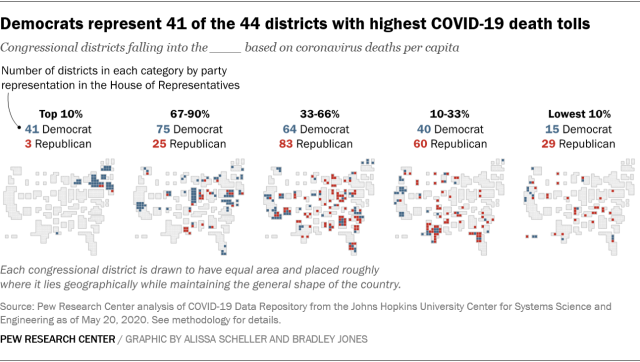
The Pew Center produced an interesting graphic showing why COVID-19 has a partisan divide (with Democrats tending to think it is worse, and Republicans not so bad). It turns out that most of the hardest hit Congressional districts have Democratic Representatives:
This is an interesting graphic that's becoming more common. Each Congressional District is represented by a square of the same size. These are grouped into shapes roughly approximating the shape and position of states. Because the population of Congressional Districts are close to equal, this data doesn't have to be scaled.

Since most deaths are in the northeast, and the Democrats are strong in the northeast, 41 out of the 44 hardest hit districts are Democratic.

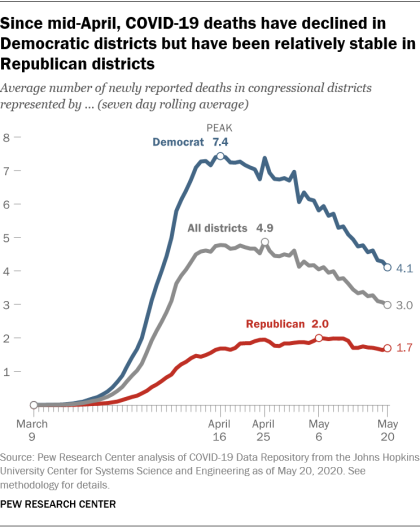
Here's another interesting tidbit: Democratic districts are getting their death rates under control:
Republicans ... not so much.

*************************************

Israel reopened schools a couple of weeks ago. And now they have a superspreader event in a high school, with 103 cases.

Offical figures from Iran indicate they are in a second wave that is nearly as strong as their first wave (which officially peaked around April 1). Dissidents claim that deaths are about 6 times higher than the official numbers.

In other upper level economics classes I'd guess that you talk about "natural experiments" (these are rarer in macro). Well, the U.S. is going through a huge natural experiment right now with all the protests: we're going to find out the hard way how transmissible SARS-CoV-2 is in the open air and sunshine. My guess is ... not very.

Japan looked really bad a month ago. How'd they fix that?

Do you remember a month ago when the models were forecasting 100K U.S. deaths by August. Yeah ... we hit that mark 3 months early ... and people think things are getting better. They are, barely. But mostly what is going on is that people are ignoring the truth. Sorry to have to write that.

China has concluded that the wet market was not the source of the virus.

And in Washington, cases are rising amongst those under 40.

Sunday, December 8, 2019

Infographic: The World’s Money and Markets

This is good but not great. (All my comments are up here because the image is so large, here is the original in its own web page with comments). I have 3 big complaints. There’s also a fourth group of stuff to love because we don’t often see it elsewhere.

  • There’s some crossover between different categories, so some things are double-counted. Some examples are:
    • Several of the “Biggest Companies” biggest shareholders are listed in the “50 Richest People”.
    • The “Fed’s Balance Sheet” includes the USA sub-category under “Currency”. And BTW: which side of the Fed’s balance sheet is shown there, or is it both (or do the visualizers not have that straight in their own heads?)
  • There’s some mixing of stocks and flows. For example:
    • The category “50 Richest People” (in the world) is followed by “California’s GDP”. But the former is a stock and the latter is a flow. A way to think about this is that they are related by a rate of return. Assume that’s 10%/year to make things simple. Thus, the flow of income coming of the wealth of the 50 richest people is about 2 blocks. When compared to the flow of California’s GDP of 26 blocks (yes, there’s a mistake in the chart there) it doesn’t look so big. Even better, California’s flow of GDP is generated by a stock of wealth that’s 10 times as big, so an appropriate comparison is the 19 blocks for the “50 Richest People” to the 260 blocks of wealth in California.
    • But that comparison is insightful because the size of the sub-category “United States” under “Stock Markets” is only 73 blocks. Figure about 10 of those are in California. So somehow, California has 260 blocks of wealth of which just 10 are the market’s net worth of corporations. This tells us that most of what is productive in our world is not in corporations, which begs the question of why on earth so many politicians are so concerned with limiting them.
  • They need to be careful about what are assets, what the liabilities are, and what net worth (the difference between the two) is. For example:
    • They only have some portions of assets listed (e.g., “Gold”, “Currency”) but then they show a much more inclusive and comprehensive “Global Debt” category. This makes debt look too large.
    • They also show capitalization of “Stock Markets” which is a net figure. What are the assets and liabilities associated with that?
    • The same thing goes for derivatives. They talk about the zero-sum nature of most of those, but they don’t actually show it.
  • This is a good example of the “balanced reporting” and “what passes for expertise” problems from my Why Is Macro So Hard lectures. In the sidebar about derivatives, they quote Dr. Richard Sandor (why does he get a title if it isn’t important to the position he takes?), Warren Buffet, and Jeff Greene. So what you have there is a guy who markets derivatives, a guy who’s rich mostly from non-derivatives, and a guy who got rich from derivatives. Any expertise there on the history of derivatives, why we have them, or why they’re useful??
  • Most people who are buggy about money being backed by something think it has to be gold (in Fort Knox!!). The sub-category “Central Banks & IMF” shows how small that component actually is.


Saturday, July 27, 2019

Why Is Macro So Hard? Marx, Engels, and Plato

The Open Syllabus Project tracks over 100K college syllabuses to see which texts are used.

At number 3 is The Communist Manifesto by Karl Marx and Friedrich Engels (this is the shorter, more political than economic book, that is often paired with readings from the 3 volumes of Marx’ Capital).

WTF.

My guess is that this may be the primary exposure to economics that many students get.

An analogy would be if Paley was read by far more students than Darwin.

This is not to say that Marx wasn’t a great economist. He definitely recognized and discussed the big unsolved or unaddressed problems of his day. But that was half to 2/3 of the way back to Adam Smith. A lot has happened since then. That’s like contemporary chemists reading Priestley: old, seminal on some points, and woefully wrong and out of date on others.

And Marx’ labor theory of value, his core idea, was a failed attempt at explaining the paradox of value. An important aspect of why it failed is that he came up with an answer before others did, that was later shown to be flawed by the marginal revolution. In most fields, that would be called a valiant attempt, with emphasis on the attempt part.

And yet, I have never, ever, had an incoming student at any level who could explain why it was wrong. This makes me think that while # 3 is being covered a lot, an essential part of the story is being left out.

In context, Marx is best thought of as a low and thick branch on the tree of economics knowledge. It was a worthwhile direction to go as the field explored new directions. But when it didn’t work out, economics as we now understand the field to be, backed out of that branch and went down the others, and flourished.

At number 2 is Plato’s Republic. OK. I’ll give on this one. It’s a great and seminal piece of social thought. But I wonder how many students get through as much of it as they can and come out the backside understanding that it doesn’t have much to do with democracy, republics, and elections as they’ve come to understand them?

In an event, as an economist, I find this work to be blissfully unaware that decentralized exchange is important or worthwhile. And yet understanding of decentralized exchange is what economics is all about.

A case in point is the prisoners’ dilemma. It wasn’t until halfway through the 20th century that a couple of mathematicians hit on a fundamental problem for understanding economics: optimal choices do not always lead to optimal outcomes. Plato knew nothing of this when he considered the best government to be that of an all-wise and all-knowing philosopher king, who made nothing but optimal choices.

So why is macro so hard? Because these authors are blithering idiots on the subject of what we now call economics, or on the subject of economics as presented in the news every day. If this is informing students’ viewpoints on some topics, no wonder they find what we do difficult.

I’ll even update my analogy. Paley was at least talking about some of the same things as Darwin. Better yet would be Origen and Augustine, discussing diversity without any conception of the random part of random selection producing it. That’s what teaching Marx, Engels, and Plato is doing to college students.

Wednesday, July 24, 2019

Why Is Macro So Hard? Don’t Measure What You Don’t Want Others to Find Out

Here is an example from Berkeley passing a sin tax on sugary sodas. The goal of these is allegedly to combat obesity. If so:

The problem with the way the soda tax is implemented, however, is that the city treats the policy as a settled issue rather than an experiment. It does not account for the possibility that the policy may fail. In fact the city’s decision-makers do not even bother to outline what they would consider a success for the soda tax in terms of reduced obesity. They have not announced any plans to track the tax’s impact on obesity rates. Thus, even if the policy fails to reduce obesity, the tax will likely continue.

Maybe the purpose of the tax isn’t really to combat obesity at all. Maybe it’s just to raise money. Cold Spring Shops (linking to this article, with more here and here) quotes that those two probably don’t go together

As with all sin taxes, there's a contradiction at the heart of California's proposed soda tax: the policy is supposed to both dissuade soda purchases and raise significant revenue from taxing them. To succeed on one metric is to fail on the other.

The reasoning is nothing if not obvious:

  • If the tax is going to reduce obesity by discouraging people from buying sugary drinks, then their demand must be elastic. So little tax revenue will be collected.
  • If the tax is going to raise revenue, it must do so because people will buy the sugary drinks in spite of the tax, because their demand is inelastic. So obesity won’t change much.

Ya’ can’t be elastic and inelastic at the same time.

Thing is, if they knew this, it would make sense to discourage collection of data.

It all makes sense now …

Tuesday, July 23, 2019

Some History of Government Backed Mortgage Lending

Any decent explanation of the financial crisis of 2006-9 needs to include the implicit backing of mortgages with taxpayer dollars. In the U.S., most mortgages are backed by GSE’s. Backing means that if those real estate purchases went well, the mortgagee/buyer keeps the gains, but if they do badly and the mortgagee/buyer walks away or declares bankruptcy, the holder of the mortgage covers the loss.

Note that I do not say mortgager. Most mortgages are offered/written and/or contracted by local financial institutions. The money to make those loans often comes from GSE’s. And the mortgages, once written, are often bought by GSE’s; they then receive the payments as their income to finance their operations, including making new loans.

And what’s a GSE? That’s short for Government Sponsored Enterprise. Basically, there is no private entity doing some thing (usually because it is a dumb idea that won’t make money). So the government creates/sponsors one. These then operate sorta’ like private corporations. Except: 1) they’re located in D.C. and report primarily to politicians and bureaucrats, and 2) if they go bankrupt it’s seen as something that must be prevented at all costs, so those politicians pony up tax revenues to keep them running. There are lots of GSE’s in the U.S., and in other countries too.

In the U.S., the big GSE’s involved in housing are the FHA (Federal Housing Administration, this one is actually part of the government), Fannie Mae (Federal National Mortgage Association), Freddie Mac (Federal Home Loan Mortgage Corporation), and Ginnie Mae (Government National Mortgage Association).

******************************************************

N.B.

It is an urban myth that real estate is always good investment. That’s why they needed to create GSE’s: they wanted to jump start a type of investment that markets deemed unwise for most people.

The sense in which contemporary real estate purchases are a “good investment” is that you are allowed to make the purchase mostly with borrowed money, and the protections for the buyer if the investment goes bad are stronger than with other investments.

Basically, it’s heads you win, tails someone else loses … set up with an investment that is mediocre. That creates a moral hazard.

Financially, it also makes home purchases like buying a call option, with the attendant agency problems.

Here’s the thing (or two things). Our mythology of America is that the Great Depression was caused, in part, by people buying stocks with borrowed money. So Congress’ solution to that was to make that hard to do, but make it easy for people to buy houses the same way. Duh! And, most people are told to shy away from buying options, and yet they’re encouraged to buy homes as options without telling them that they now have an option. Double-duh!

******************************************************

D.C. likes to tell us that reforms instituted after 2008 (including Dodd-Frank) cleaned up this mess.

Most economists do not find this credible. While Dodd-Frank did many things, it did not address the fundamental problem: there’s moral hazard involved in borrowing someone else’s money to buy a home. Further, homes are probably the last asset you’d like people to buy with borrowed money: they’re not very liquid, and you can’t shop them around to different locations in the hopes of finding buyers willing to pay more for them.

******************************************************

All of this is a lead up to an informative blog post by Kevin Villani at Chicago Boyz. It turns out that Villani has way more expertise on this than most people. Here’s his bio:

Kevin Villani, chief economist of HUD during the Carter and Reagan Administrations and Freddie Mac from 1982 to 1985, is the author of Occupy Pennsylvania Avenue on the political origins of the sub-prime lending bubble and aftermath.

Here’s the history of these GSE’s, in a nutshell:

U.S. secondary markets evolved entirely in response to anachronistic political forces. FHA was created in 1936 to stimulate new construction jobs [not a bad idea during the Great Depression] subsequent to a huge housing construction boom [it worked]. Fannie Mae was created two years later to prop up flagging demand for FHA mortgages [investors didn’t have money for mortgages before, and they didn’t still when FHA marketed more of them]. Ginnie Mae was created in 1968 to liquidate Fannie Mae after prior privatization attempts failed … Rather than liquidate, the privatized Fannie turned to funding conventional mortgages for their mortgage banker clients. To protect their turf, portfolio lending savings and loans [S&L’s were a different type of bank, also created by legislation during the Great Depression, which have largely ceased to exist, except in name, when many of them crashed in the financial crisis of the late 1980’s] then demanded their own secondary market facility, Freddie Mac. It later privatized mainly to provide management incentives comparable to Fannie, particularly stock options.

They then morphed into massive public directed credit institutions, with profits from government subsidies privatized but otherwise lacking the benefits of market efficiency and discipline. About half of F&F subsidies were captured by shareholders, managers and politicians (my estimates) … [Bracketed comments are from me. Parenthetical comments are the authors].

Many presidential candidates, and much of Congress is interested in further reforms. Villani points out what we’ve learned so far:

  • Private markets operate on one set of incentives and accountability, government on an entirely different set. Each has its problems and imperfect solutions.
  • Private markets may inappropriately discriminate against qualified borrowers, for example, whereas public programs may fail to adequately discriminate.
  • Public enterprises created to jump-start or complement private markets often miss the mark, with unintended consequences.
  • Politicians much prefer to deliver subsidies through taxes (in this case tax exempt debt substituting for taxable equity) rather than expenditures – especially since the Budget Control Act of 1974 – and implicit off-budget credit guarantees that delay the reckoning.
  • In spite of good intentions and design to get the best of both, privatized hybrid public-private systems inevitably embody the worst: public risk for private profit. Lacking both market and public discipline, they cause systemic failure that “nobody could have seen coming.”
  • Political reform reflexively blames private market failure, doubling down on unaccountable and ineffective bureaucratic methods while providing opaque bailouts through greater tax and credit subsidies.
  • Political reform starts with what is, not what should be, repeating the cycle.

Read the whole thing. Highly recommended.

Anyway, d’ya think mortgage finance is a big enough issue to be covered in macroeconomics classes? Yep.

And, it’s common for people to make the claim “no one told us this could happen”, but I can attest that the moral hazards of GSE’s in the housing market has been part of my macro classes for 30ish years.

Oh … and … student loans are financed the same way (through, you guessed it, Sallie Mae). Just sayin’ …

Thursday, June 27, 2019

Why Is Macro So Hard? Bias Against Emergence and Bias Against Understanding

Macro is hard because journalists (and many of the rest of us) overweight conscious action by individuals — decisions.

If we overweight something, we must underweight something else — and that’s emergence: the idea that some things happen through the interaction of all of us rather than through conscious planning.

Cold Spring Shops pointed me towards a couple of pieces and Stumbling and Mumbling that cover this well, in the context of Brexit and the rise of Boris Johnson. Not all of this is relevant here; I’ve emphasized the parts I like best.

I fear that we have here is another example of a bias against emergence. Political journalists especially focus upon conscious political actions to the neglect of emergent processes.  Brexit is a political choice whereas other, perhaps bigger, influences on real wages are the complex unintended products of millions of dispersed decisions. So Humphrys pays the former more attention.

Nor is it confined to journos. Leftists sometimes blame rising CEO pay on bosses’ greed, as if the rest of us would turn down pay rises, and under-estimate the extent to which it is the result of partly-emergent processes such as globalization (pdf), deunionization, agency failure or managerialist ideology.

In this respect, the BBC has what John Birt and Steve Richards called a “bias against understanding.” In downgrading the importance of emergence, it stops viewers and listeners from understanding social phenomena.

But this all leads to a disturbing conclusion:

If this bias merely led to ignorance, it wouldn’t be so bad. But it might have a more systematic effect. If we underweight emergence, we overweight the role of conscious individual agency. This causes us to exaggerate what politicians and business leaders can achieve if only they display strong leadership. And that, in turn, helps to sustain inequalities of income and power.

It gets better in the second piece:

The thing about complex emergent processes is that they are hard to understand – there’s a complexity brake – and even harder to forecast. This might explain why economists have generally failed to predict recessions in a timely manner.

This is why I say the BBC is guilty of an ideological bias. In not even considering the question of emergence, and instead pretending that markets are like people, it is assuming that complex social phenomena – not just markets but perhaps political behaviour too - are understandable and predictable.

This is no mere innocent error. If markets are like toddlers or teenagers, it’s possible to understand and predict their behaviour and so Very Serious People can claim to possess expertise and hence a legitimate right to power and influence in politics and business. If, however, they are instead complex processes they might not be predictable – except in the sense that we might know the probability distribution of possible outcomes – then those VSPs are in fact mere empty suits.

As Alasdair MacIntyre wrote:

Do we now possess that set of law-like generalizations governing social behaviour of the possession of which Diderot and Condorcet dreamed? Are our bureaucratic rulers thereby justified or not? It has been insufficiently remarked that how we ought to answer the question of the moral and political legitimacy of the characteristically dominant institutions of modernity turn on how we decide an issue in the philosophy of the social sciences. (After Virtue, p 87)

In unthinkingly denying the very possibility of complexity, the BBC is therefore helping to shore up the power and prestige of the ruling class. That’s a profoundly politically biased position.

I love that. And turning it on its head, it’s critical for the ruling class to assert that things can’t be emergent/complex.

My gosh … Trump may have had a huge insight when he remarked that healthcare policy was hard!

Cross-posted from my personal blog; this topic isn’t a great fit for undergraduates just getting exposed to these ideas.

Tuesday, April 10, 2018

Why Is Macro So Hard? Artificial Precision

I’m speculating here, and in a somewhat nasty way: I suspect that personality tests would show that governments are full of “control freaks”. Control issues are how therapists describe behavior in which people think things perform better because they specifically are the ones in charge.

A symptom of this is the artificial precision in many government statistics. In the U.S. we announce quarterly real GDP growth rates to an accuracy of one tenth of a percentage point. Due to annualization this is actually something a tad sharper than one fortieth of a point.

Yet, my personal opinion is that most people have trouble feeling a GDP growth rate difference of less than a percentage point. So the announcements are ten times sharper than they need to be.

Why do they do that? Most of us have experience with or as parents taking the temperature of a sick child. Doctors usually tell us not to worry (even a little) if the temperature is not above 100º F, and to not worry seriously unless the temperature exceeds 102º F. Yet many parents agonize over the tenths digit on their thermometers. At least parents have a reasonable excuse to be control freaks.

The government is doing this with GDP figures. And those are probably the most precisely measured macroeconomic statistic: others, like the deficit, are far less accurate.

We’re more mature than this. Announcers of weather forecasts get this:

RFD 18-01-11 Weather an an Approximation

They can make point estimates of forecasts that are very precise, but instead they provide us with interval estimates that are reasonably informative: like the high will be in the mid 60’s today.

Why don’t government officials behave the same way?

I think this encourages us to focus too much on unrealistic details. For example the Obama administration (and its critics) agonized over differences between 2.1 and 2.2%, when the real issue was that the economy was growing at 2% rather than 3%.

I work with U.S. real GDP data all the time. A reasonable autoregression shows that with annual data going back to 1929, the 95% confidence interval for growth is –5% to +11%.

Why worry about tenths when the range of what’s possible is so large?

Of course, you could make the argument that the annual data includes the unusual periods of the Great Depression and World War II. Fair enough. If you run the quarterly data from 1947 onwards you still get –1% to +7%.That’s a huge range of possibilities for controllers within the government to encourage people outside the government to fret over.

Tuesday, December 26, 2017

Why Is Macro So Hard? A General Absence of People Who Are Smart Enough

This is from Patrick McKenzie’s twitter thread, where he mostly talks about high tech insights:

There is no hidden reserve of smart people who know what they're doing, anywhere. Not in government, not in science, not in tech, not at AppAmaGooBookSoft, nowhere. The world exists in the same glorious imperfection that it presents with.

Stop voting for, say, Clinton, because you believe she had a hidden reserve of smart people.

Stop voting for, say, Trump, because he has a different/better hidden reserve of smart people.

The world is a statistically noisy place, and it’s too big for even smart people to fathom completely. Stop pretending that they can, and stop believing them when they say they do.

In macro, there are no hard answers. Just heuristics. Get used to it.

Technorati Tags: ,,,,,,,

Wednesday, May 10, 2017

Why Macro Is So Hard: What Passes for an Expert

This is actually an addendum to a topic that’s already part of the canon (here’s an example, and it’s been in the principles lecture on this topic for years).

So, here’s Deadspin’s headline from another example:

Florida's Go-To Stadium Economist Is A Hack,
A Shill, And Also Not An Economist

Everyone should know by now that sports stadiums and arenas are a very bad investment for their communities (and everyone around SUU should absolutely know this, given how much Berri, Price, and I repeat it).

In this particular case, Tampa is building a stadium for a team that doesn’t even have Tampa in its name.

Wha, wha, what?

Tampa is building a stadium for the Toronto Blue Jays to use for spring training.

(Now, if you’ve never been to spring training, it is a thing, but not a big thing. We’re talking about 15 or so games, held over 5 weeks, that average about 5K fans a piece.)

For perspective, Tampa is spending 4 times on this stadium what SUU is spending on new business building.

Maybe one reason is they hired a consultant who produced an economic report indicating that it was a good way to spend their money:

If Bonn’s studies don’t sound very economically robust, perhaps it is because Bonn isn’t actually an economist! He is a professor at FSU’s school of hospitality, where he teaches marketing and wine-tasting, and his degree is in resource development.

Which doesn’t necessarily mean Bonn can’t do the economic work; I also do not have a degree in economics. Then again, I don’t charge $23,000 for economic impact studies …

For clarity, Bonn wrote the report, and the “I” in the quote is the author of the linked piece on Deadspin.